

José Hernández Vargas
Architect and PhD student at KTH Royal Institute of Technology
In an essay on the analytical language of John Wilkins, Jorge Luis Borges presents a fictional taxonomy, allegedly taken from an old Chinese encyclopaedia, which divides animals into fourteen categories: those belonging to the Emperor, embalmed ones, trained ones, suckling pigs, mermaids, fabled creatures, stray dogs, those included in this classification, those that shake like mad, uncountable ones, those drawn with a very fine brush made of camel hair, et cetera, those that have just smashed the vase, and those that resemble flies from afar. Besides its evident humour, what unsettles is the fact that the list holds together at all. The eighth category the whole scheme, category twelve abandons it, and no apparent principle joins the rest, despite each entry being intelligible on its own.
Every classification carries this risk, including the ones the construction sector relies on daily. To classify is to organise objects into classes according to criteria, and the criteria chosen determine what can subsequently be found. For precast elements recovered from buildings due for demolition, the available criteria were established for an entirely different purpose, namely the design and manufacture of new components. Reuse asks a different question of the same objects, and existing taxonomies have no place to record the answer.
From hierarchies to facets
Most construction classification systems are enumerative, that is, they attempt to list every class within a domain and arrange them in a tree. Such structures are intuitive but rigid. They accommodate objects belonging to several categories poorly, and tend to accumulate residual groups such as ‘et cetera’ in Borges’ classification. Faceted systems take the opposite approach, describing an object through several independent attributes that can be combined as required. The taxonomy proposed here is a hybrid, faceted at the top level, with each facet internally organised as an enumerative hierarchy.
Two naming conventions
For individual elements, the facets are element type, country, manufacturer and factory, production year, and a local code. The resulting string SH_SE_ABTG-STRN_1973C_ASYS-B39 reads as a hollow-core slab produced in Sweden by A-Betong at its Strängnäs factory, in a building completed in 1973, listed as B39 in the A-System catalogue. The final facet is deliberate, as it preserves the original terminology of the archives instead of overwriting it.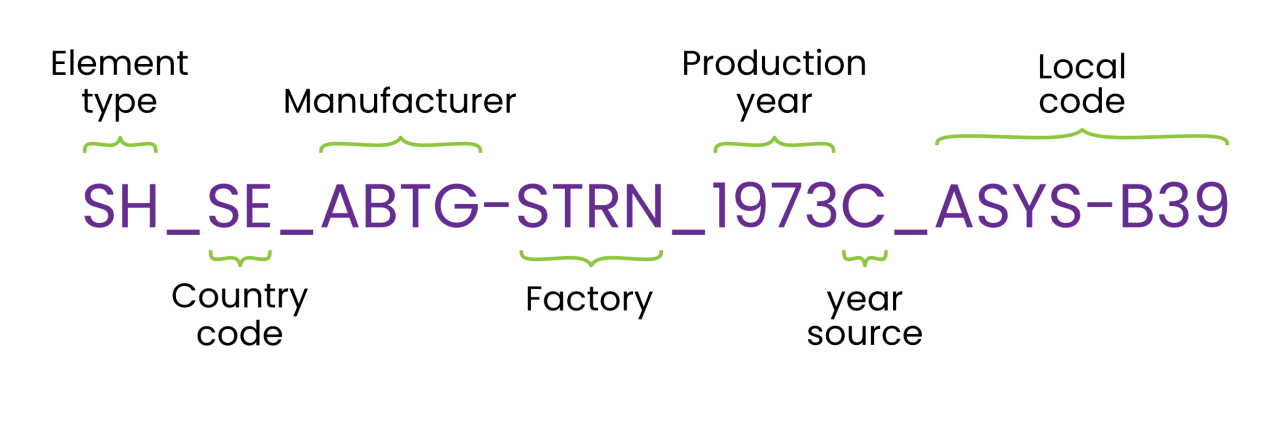
Naming convention for element taxonomies. Each facet is separated by an underscore, with the hyphen reserved for compound facets such as manufacturer and factory.
Systems are named through a parallel string covering structural principle, building typology, country, manufacturer, system name, and year. The Råslätt neighbourhood in Jönköping thus becomes CW_RE2_SE_ABTG-VIS_ASYS_1968C, a cross-wall system for multi-family housing.
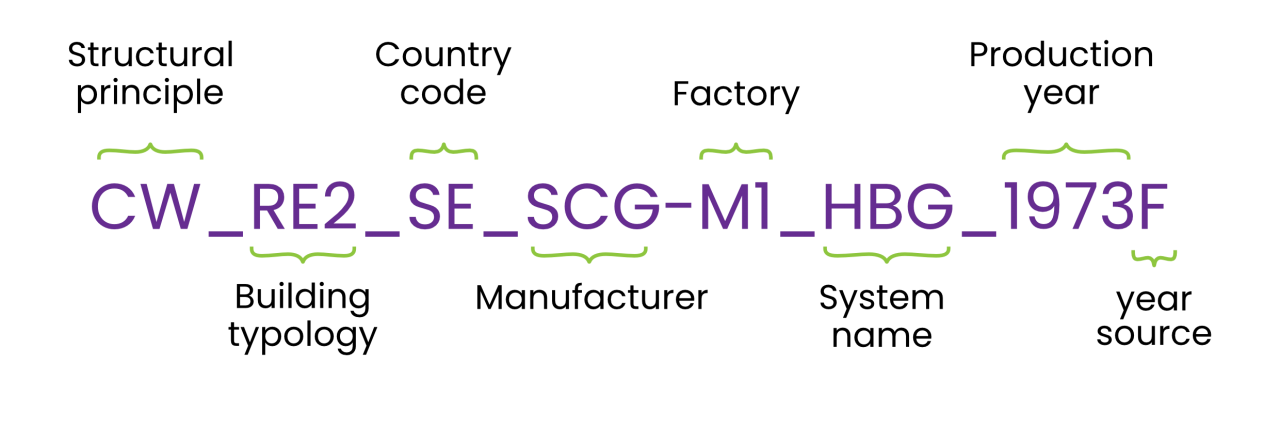 Naming convention for system taxonomies. The facets follow the same syntax as the element codes, with structural principle and building typology replacing element type.
Both conventions distinguish the ‘blank element’ defined in a catalogue from the physical instance surveyed in a donor building, which inherits the metadata of its class and accumulates its own record of tests, defects, and interventions as it moves towards reuse.
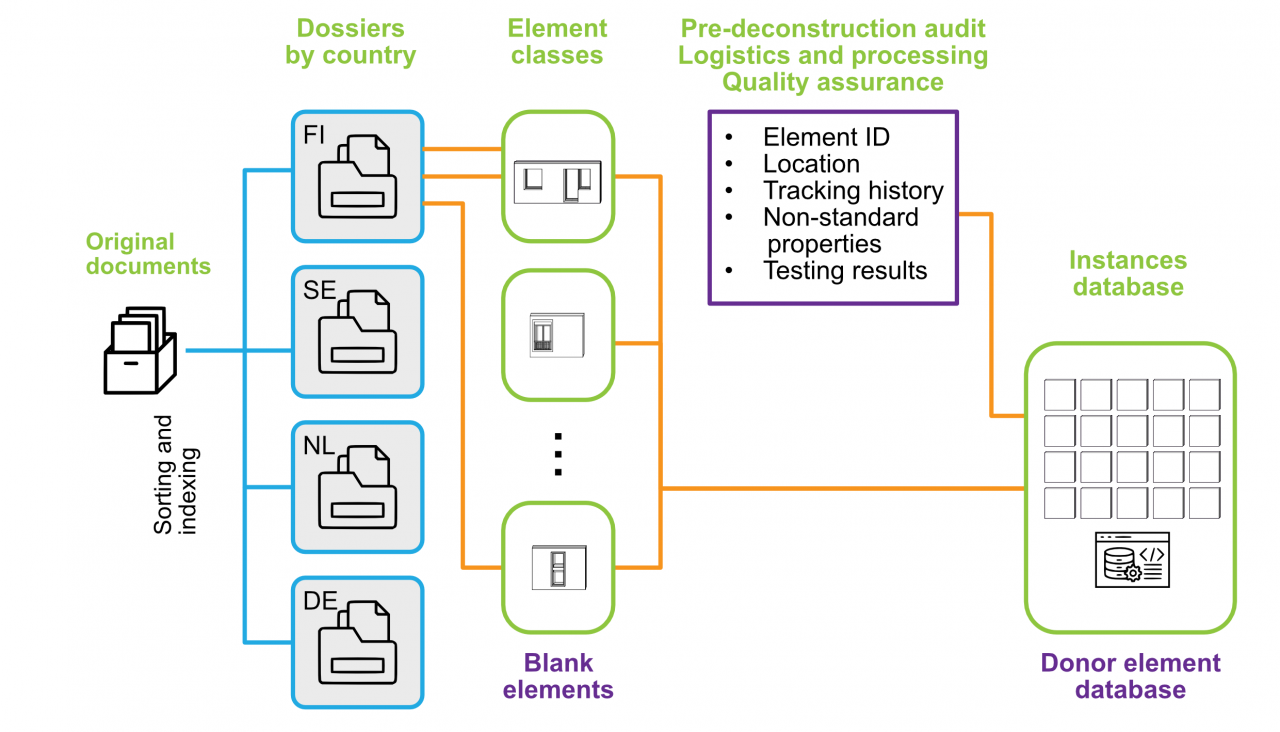
Workflow for the classification of elements. The blank element is the type defined in a catalogue, whereas the donor building element is a surveyed instance that inherits the properties of its class and accumulates its own record of tests, defects, and interventions.
Tested against five systems
The taxonomy was applied to the Swedish A-system, the Finnish BES and LBU, the Dutch VAM, and the East German WBS-70. Reconciling them proved the most demanding part of the work. Distinctions that are unambiguous in one national context become blurred in another, and each facet had to be negotiated as a compromise between precision and usability.
Alignment with ISO 12006-2, ISO 19650, and ISO 22274 keeps the scheme compatible with existing taxonomies such as CoClass. The remaining obstacle is archival rather than conceptual. The documentation is dispersed and incomplete, and most of the manufacturers that produced these elements no longer exist. Even so, these codes now provide the indexing layer for the project’s database of reclaimed elements, the point at which a naming convention may become a searchable stock.
The full report is publicly available in the reports section.