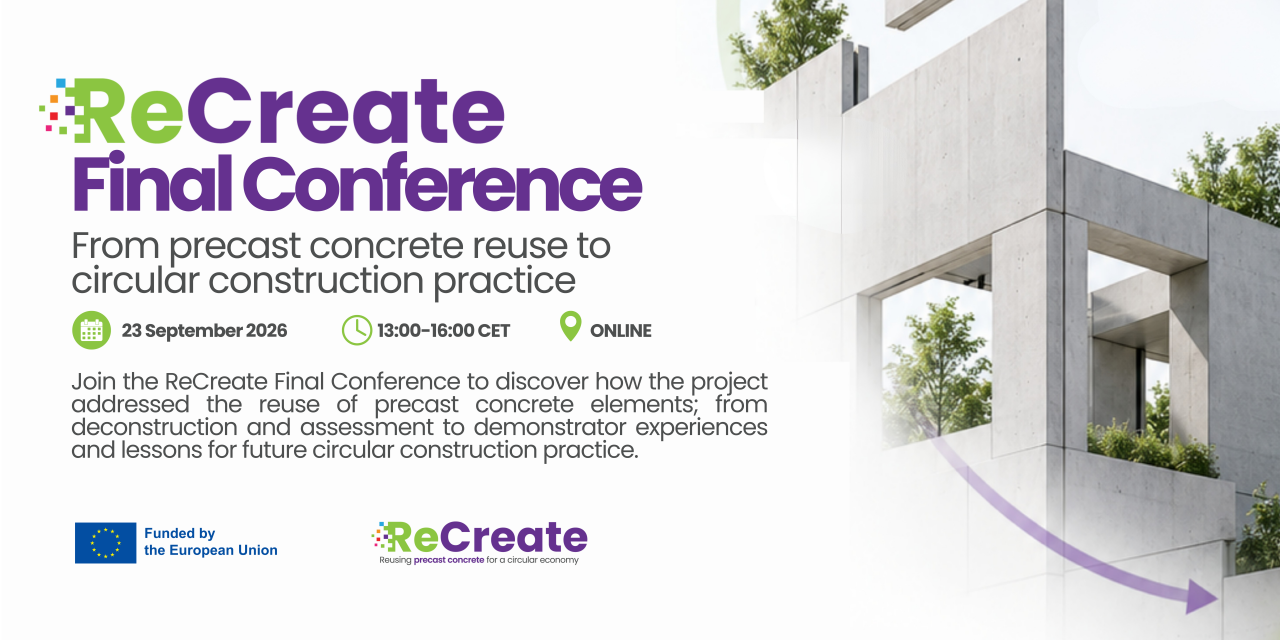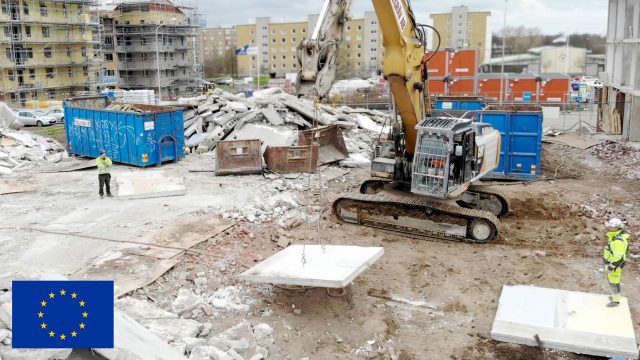

ReCreate explores how precast concrete elements from existing buildings can be identified, deconstructed, assessed, documented, redesigned and reused in new construction.
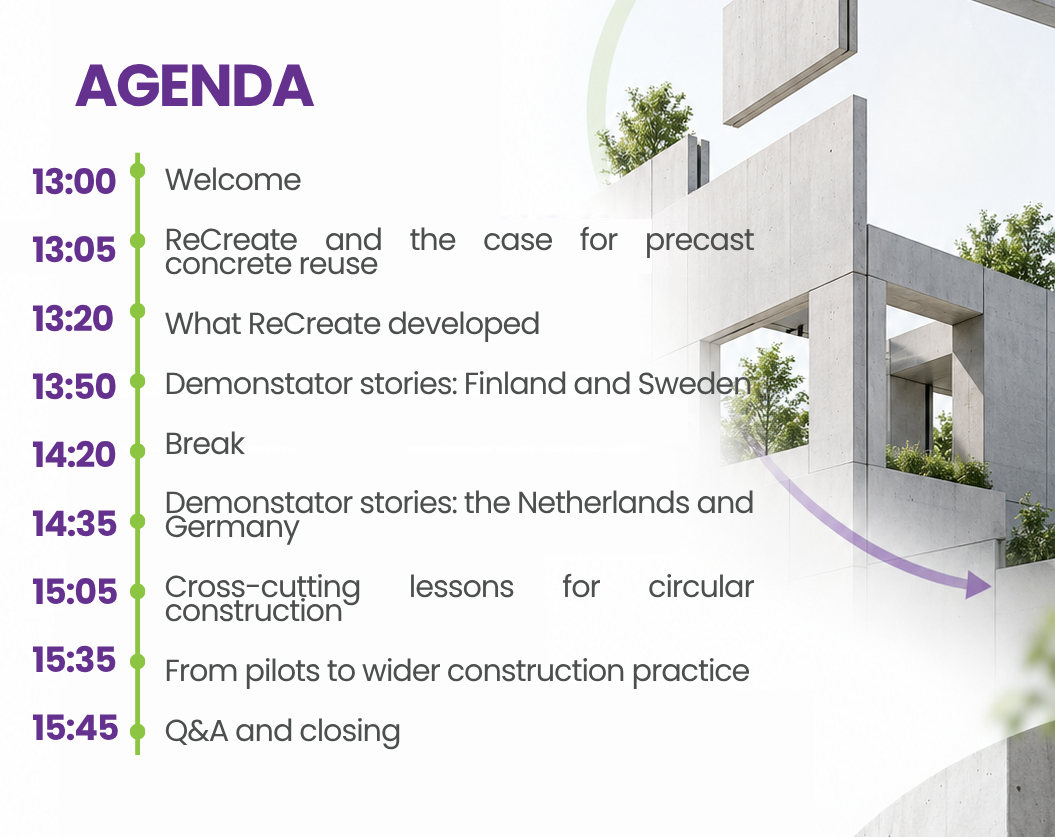
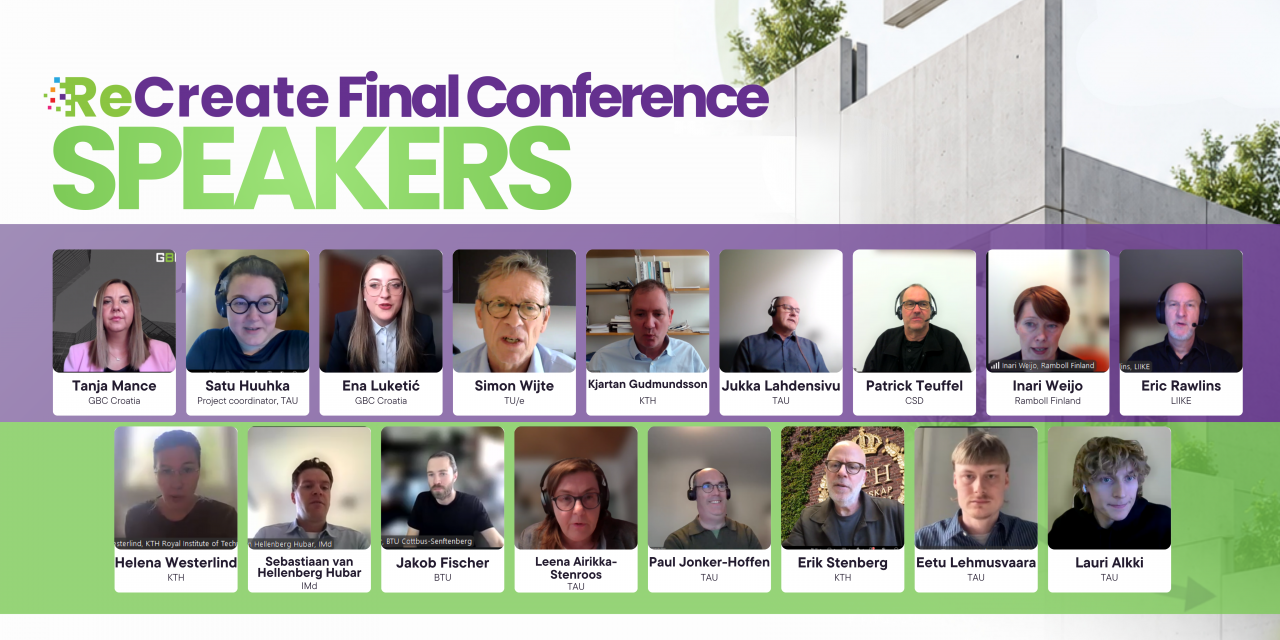
At the final conference, project partners will present the key results, practical demonstrator experiences from Finland, Sweden, the Netherlands and Germany, and the main lessons learned for circular construction practice. The detailed agenda is provided below.
The event is free and open to everyone interested in circular construction, resource efficiency and low-carbon building practices, including professionals, researchers, public authorities, policymakers, students and other stakeholders.
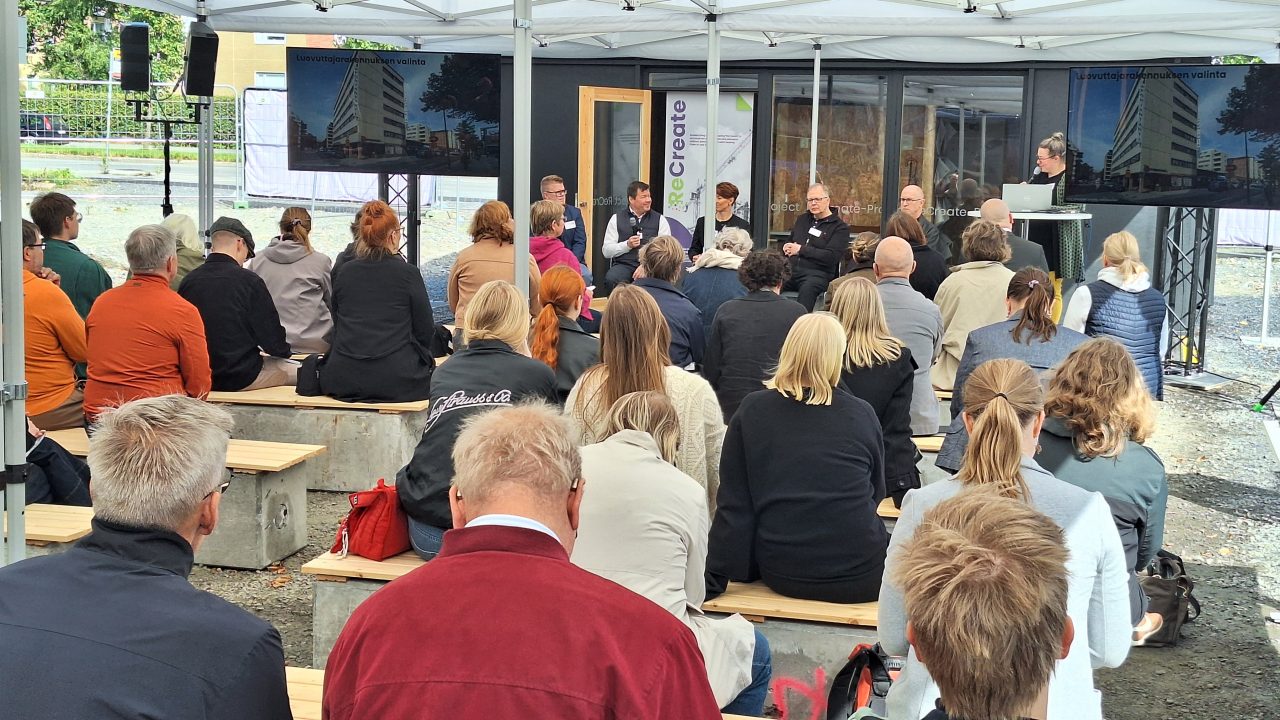
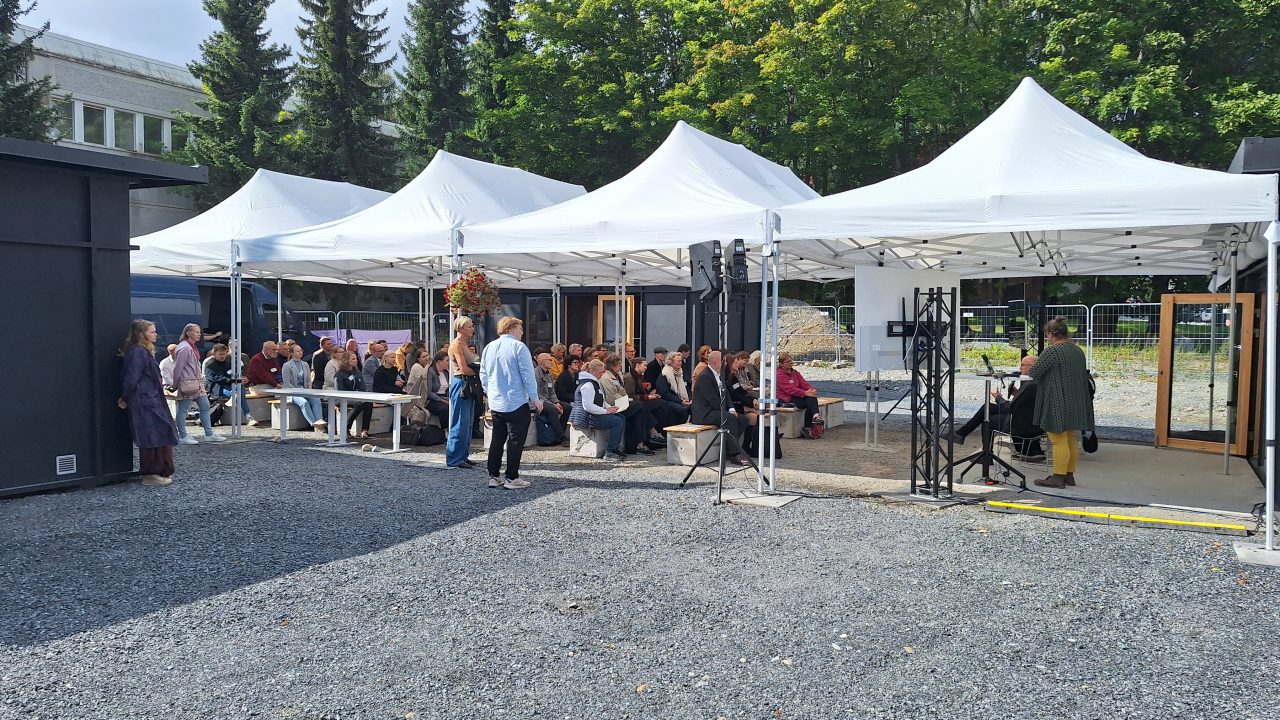
The circular economy in the built environment is taking another important step forward. The professional day organised by ReCreate’s Finnish cluster, which also served as the project’s national final event in Finland, brought together construction industry experts, researchers, and practitioners to discuss the reuse of concrete elements reclaimed from buildings slated for demolition, as well as the related opportunities and challenges.
The event was opened by two influential speakers – Deputy Mayor Ilkka Porttikivi from the City of Tampere, responsible for the Urban Environment and Infrastructure Services committees, and Finland’s Minister of the Environment and Climate Sari Multala (via video). Both speakers reminded the audience about the importance of circular economy and the construction sector in the face of the environmental challenges of today.
Throughout the day, participants heard timely presentations and examples from ReCreate’s Finnish members on how concrete elements reclaimed from end-of-life buildings can be reused as part of the low-carbon construction of the future. Discussions particularly emphasised the successful technical implementation of the process, reducing the carbon footprint of construction, and business opportunities in the circular economy.
The ReCreate project is developing operational models and solutions that enable the reuse of concrete elements safely, efficiently, and economically. The goal is to reduce the use of virgin materials and promote the construction industry’s transition toward operations genuinely based on the circular economy.
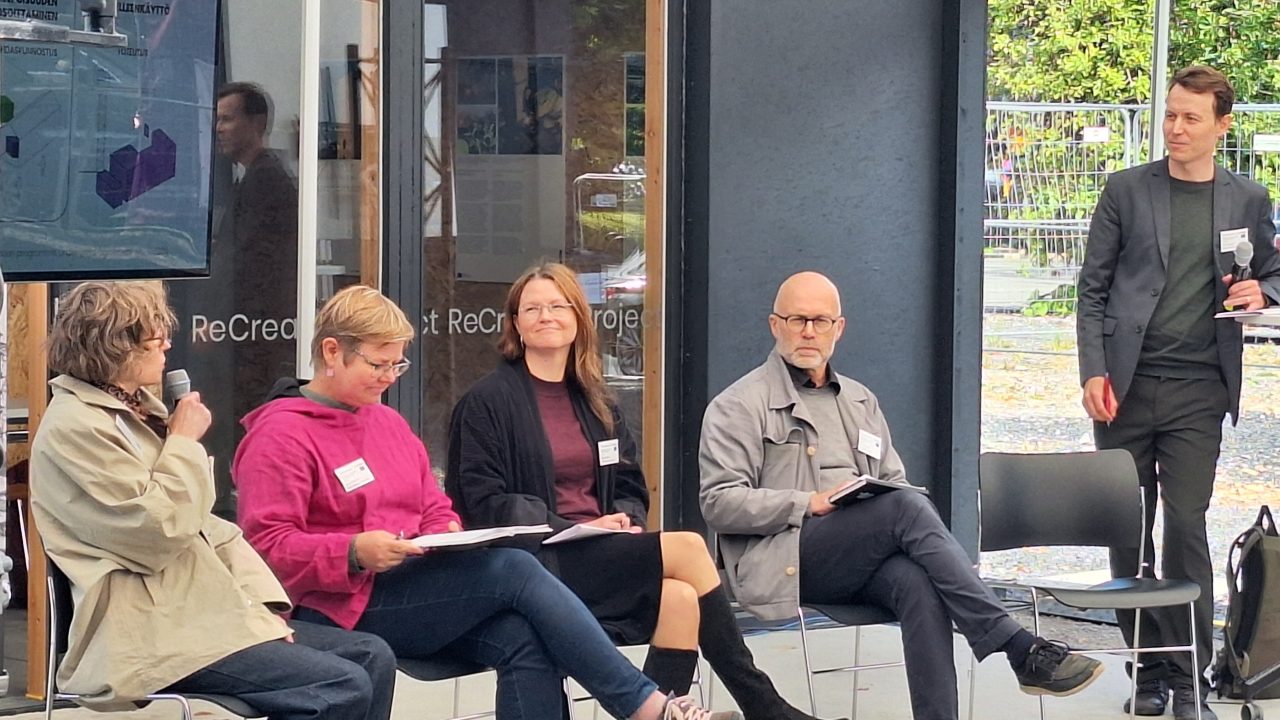
The event concluded with an inspiring panel, hosted by Green Building Council Finland’s Antti Ruuska, where four influential guests discussed how to advance the mainstreaming of circularity in construction. Member of parliament Krista Mikkonen pointed out that better regulation needs to be introduced so that construction sector actors willing to adopt environmentally friendlier solutions are not punished by higher costs. The other panelists – senior architect Harri Hakaste from the Finnish Ministry of the Environment, head of urban development Saara Melama from a major landowner company Hiedanrannan Kehitys Ltd, and sustainability adviser Mirkka Rekola from Senate Properties, also provided various insights into the topic.
The professional event held in Tampere, Finland on August 24, 2026, provided participants with valuable information on the project’s progress, research findings, and practical experiences from pilot sites. In addition, the event served as an excellent forum for networking and collaboration among various stakeholders.
If you were unable to attend the event in person or would like to revisit the day’s most interesting presentations, you can now watch the recording of the Professionals’ Day at a time that works best for you.
Through the recording, you’ll gain insight into the latest perspectives and solutions in the industry and learn how the reuse of concrete elements can accelerate the construction industry’s transition to sustainability and open up new opportunities for future projects.
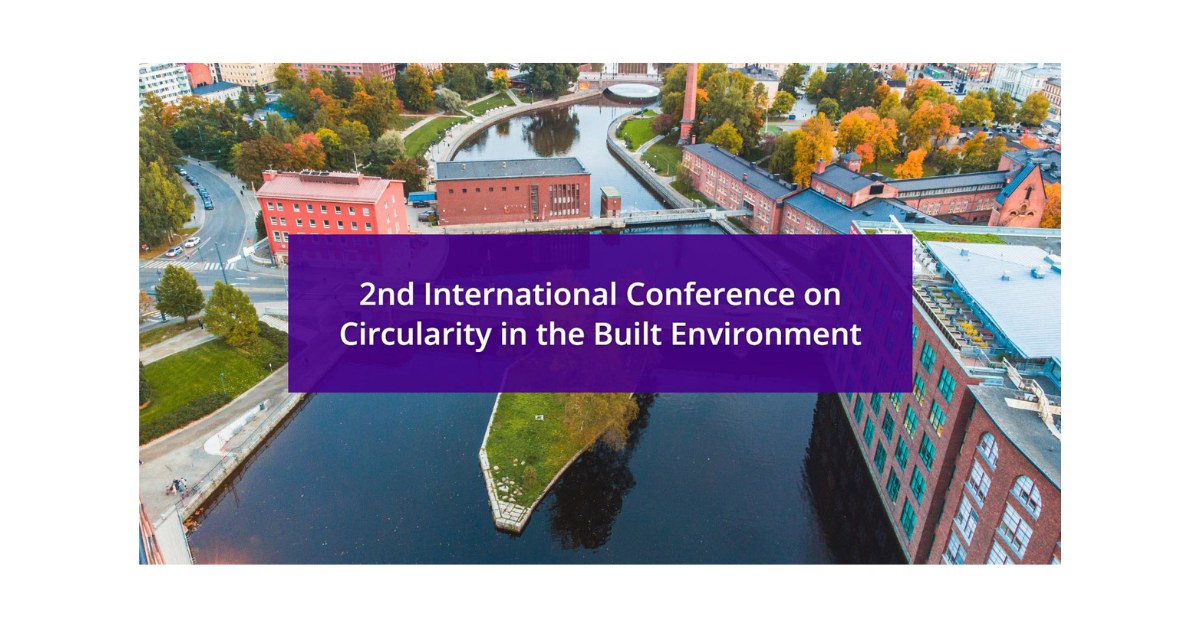
16-18 September 2025
Tampere Hall congress centre
Tampere, Finland
(street address Yliopistonkatu 55)
About the conference
The 2nd International Conference on Circularity in the Built Environment (CiBEn) brings together pioneering researchers from all over Europe and beyond to share knowledge on the state-of-the-art on circular construction. Organised in collaboration between Tampere University (Finland), TU Delft (the Netherlands), KTH (Sweden), Brandenburg TU Cottbus-Senftenberg (Germany), TU Eindhoven (the Netherlands), Circular Structural Design (Germany), Green Building Council Croatia and the Horizon 2020 project ‘Reusing precast concrete for a circular economy’ (ReCreate), CiBEn 2025 aims at becoming a major point of contact between researchers and practitioners dealing with all aspects of a sustainable circular economy in the built environment.
Main page image: Laura Vanzo, Visit Tampere
Important dates
Abstract/short paper submission
The submission is open here!
Please submit your contribution by April 30, 2025 (at the latest)
We encourage authors to submit early, for contributions are sent to peer review as soon as they are received.
Acceptance notifications
June 30, 2025 (at the latest)
Acceptance decisions are made as soon as the contribution has been peer reviewed and if needed, revised.
Presenters’ registration deadline June 30, 2025 (early registration rate)
August 15, 2025 (late registration rate)
Conference September 16-18, 2025
Publication
Accepted abstracts and short papers are published in the conference proceedings upon the conference. The proceedings will be available online in Open Access and have DOI and ISBN numbers.
Find out more about the Call for Contributions, Programme, Keynote Speakers, Travel and Accommodation, and other important details on the official event website. Click the link below to stay informed on time.
ReCreate representatives from Sweden, Erik Stenberg and Helena Westerlind, project coordinator from Finland, Satu Huuhka, and Eetu Lehmusvaara (TAU) are preparing to exhibit the project in the Tallin Architecture Biennale 2024.
Description taken from the official website of the exhibition:
“7th Tallinn Architecture Biennale (TAB) will be titled “RESOURCES FOR A FUTURE” and curated by Anhelina L. Starkova, Kharkiv; Daniel A. Walser, Zürich; and Jaan Kuusemets, Tallinn.
TAB 2024 will be held in October – November 2024.
Architecture needs to play a key role in future change. Hereby resources are one of the main factors in the future development of our planet. TAB 2024 explores architecture and urban planning from the perspective of resources. The exhibition will focus on different parameters of resources such as building materials, typologies, orientation, and architecture to the level of urban planning and society. The exhibition will have a world-wide perspective with a local base and call for action.
After Sustainability: Architecture Remains
Escalated global tensions imposed new tasks on architecture, where architects are left with a reduced amount of resources for the creation of social mobility, diversification, and changeability as the usual parameters of conceiving architecture. What approach must we take in such a setting? The mass architecture will not disappear, but it needs to accept the resources available to it. Access to quality in architecture should not be limited to a fortunate minority. To sustain social cohesion, we have to create environmental opportunities for everyone. Architecture serves beyond aesthetic purposes; it’s a powerful transforming tool that creates social life, but for that, we have to raise the building profession by moving it into the architecture of the unseen, unpleasant and hidden.
How to conceive and construct an architectural program that remains stabilising enough to support architecture amidst ever-changing environmental conditions in perpetual crisis?
We are facing a challenge to operate within unsustainable and prevailing conditions that need to be converted into resources for the future development of society. Utilising local resources would reinforce existing structures and facilitate the transformation towards improvement and progress. Defensiveness and reusefulness will be the basis of future construction in architecture. Buildings need to be in use for a much longer time, despite our economically driven lifestyle.”
We are thrilled to announce that the ReCreate project will be featured among other EU-funded initiatives at EU Industry Days 2023, set to take place from October 4th to 6th at the FYCMA (Trade Fairs and Congress Center of Málaga) in Spain. This event promises to be a melting pot of innovation, where industry leaders, policymakers, and experts will converge to accelerate the digitalization, sustainability, and efficiency of production models in Europe.
EU Industry Days, the European Union’s flagship annual event dedicated to industry, is making its way to Málaga. It serves as a vital platform for forging connections, fostering collaborations, and driving innovation across various industrial sectors. At the heart of this event is the mission to facilitate Europe’s transition towards a more sustainable and digitally advanced industrial ecosystem.
ReCreate is an EU-funded project committed to redefining construction through the reassembly of precast concrete elements, thus contributing to circular construction practices. By examining the entire construction and demolition ecosystem, ReCreate explores systemic changes needed to maximize the reuse of precast structural components, preserving their secondary materials at their highest value.
We invite you to visit our exhibition at EU Industry Days 2023 to learn more about the ReCreate project and witness firsthand how circular construction and sustainable practices can shape the future of our industry. Join us in Málaga as we collectively work towards a more innovative, collaborative, and sustainable industrial landscape.
Don’t miss this opportunity to be part of the transformative journey in the European industrial sector. See you at FYCMA in Málaga from October 4th to 6th!
Answering the challenges of tomorrow requires bold and visionary solutions and initiatives
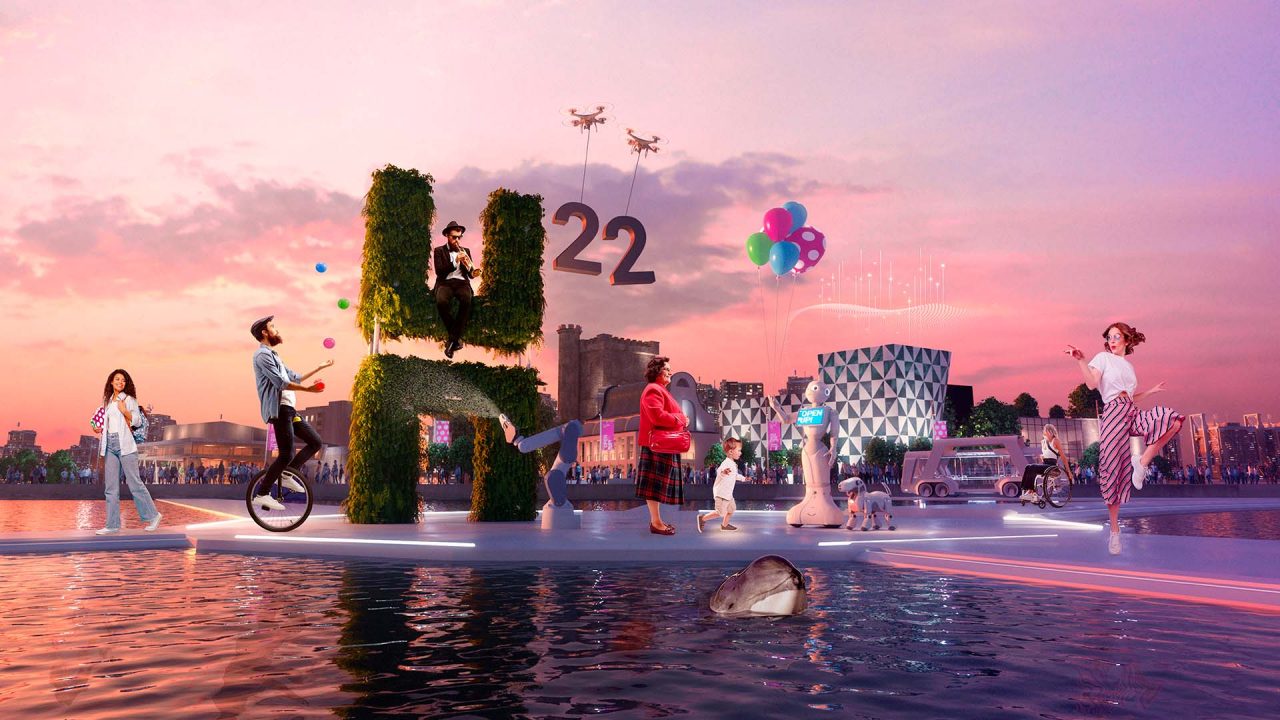
H22is an ambitious initiative brought by the city of Helsingborg to develop future solutions directed at improving the quality of life in a smarter, more sustainable city.
That is why the initiative is organizing the H22 City Expo – an international event in Helsingborg that will run for 35 days and that will also serve as a platform for presenting innovative work and new solutions. The key focus of these solutions pertains to welfare and urban development, or in other words, how innovation can help improve the quality of everyday life for everyone living and working in Helsingborg.
H22 City Expo will gather the world’s visionary leaders and urban disruptors to explore local solutions for the global challenges that will define our future – and where cities must lead the charge.
Cutting edge technology, future homes, and the newest takes on a sustainable city will be heavily featured in the expo. Visitors and residents of Helsingborg will be able to interact with hundreds of innovative ideas and solutions and will also be able to put forth their own input! Each participant will be a living component in an urban lab that brings together industry leaders, public sector pioneers, and passionate residents to develop, share, and test real-life solutions in real-time.
ReCreate @ H22 City Expo 2022
Concrete is a big challenge for the climate and also one of the most important components of our buildings. The main goal of the ReCreate project is to introduce the concept of circularity into construction and to make the construction of new buildings and our future homes with reused concrete elements a viable option for the future of sustainable construction. It also examines the systemic changes needed throughout the construction process, from demolishing to the design of new buildings, to making circular building standard practice.
Areas such as Drottninghög in Helsingborg are in need of revitalization and development. Demolishing and building new buildings entails creating a greater environmental impact, more waste, and an increased use of resources in comparison with maintaining and renovating buildings. That is why reusing materials such as concrete could be an important method with which a reduction of the negative environmental effects could be achieved.
The Swedish contributors, KTH,Helsingborgshem and Strängbetong are presenting their first results and practical examples of how building materials can be reused.