Introduction to the report Business model canvases for precast concrete element reuse of the ReCreate project. Full report is available here.
Mikko Sairanen, Tampere University
For companies to adopt the novel practice of reusing precast concrete elements, it is essential that they understand what this entails regarding the value that their customers perceive, dynamics of creating and delivering such value, and, of course, turning a profit in the process. In other words, they need to form an understanding of what is the business model for precast concrete element reuse.
To aid the industry in this challenging task, in ReCreate project, WP7 has examined the issue and put together business model canvases (BMCs) for the different types of companies and processes that are needed to realize precast concrete element reuse. The BMC is a popular tool that can quickly communicate the essential elements of a business model, such as the required key activities and resources, customer-related information, and cost and revenue streams.
Three key insights from the BMC analysis are discussed here. First, precast concrete element reuse holds significant business potential, but issues of economic feasibility remain. We found that labour costs are the biggest barrier to address in order to build competitive business cases out of concrete element reuse. While savings can be attained in material and waste management costs, time-consuming deconstruction and element refurbishment processes challenge profitability. This issue can, however, be greatly alleviated through learning and gradual scaling of reuse processes. In addition, appropriate policy mixes are needed to economically incentivize reuse compared to virgin concrete element production.
Second, the business models of the value chain are heavily affected by value chain organization, particularly regarding vertical integration. Within the ReCreate pilot projects, we have observed both so-called decentralized and centralized organization models. A decentralized model means that the companies of the value chain adopt rather well-defined tasks such as deconstruction or element refurbishment and that the value chain is built on collaborations rather than coordination from a single company. In a centralized model, however, one company vertically integrates various value chain functions and thus designs a new overarching business model for concrete element reuse. The optimal way to organize the value chain depends on the regional business environment and markets, but we found that the focal company in the centralized model can often execute several reuse subprocesses very efficiently, ensure smooth data management, and, crucially, match emerging demand with specific deconstruction projects early on. These attributes of vertical integration can support building attractive business models in the emerging markets of reclaimed concrete elements.
Lastly, we highlight that the business models need to not only work at the level of identified company types within the ReCreate pilot projects, but also at the level of any subprocess that could be considered a standalone business process in the future, as well as at the level of the whole value chain. Therefore, we also analysed BMCs for the key supporting processes of quality management, storage, and logistics, as well as for the system level (picture below).
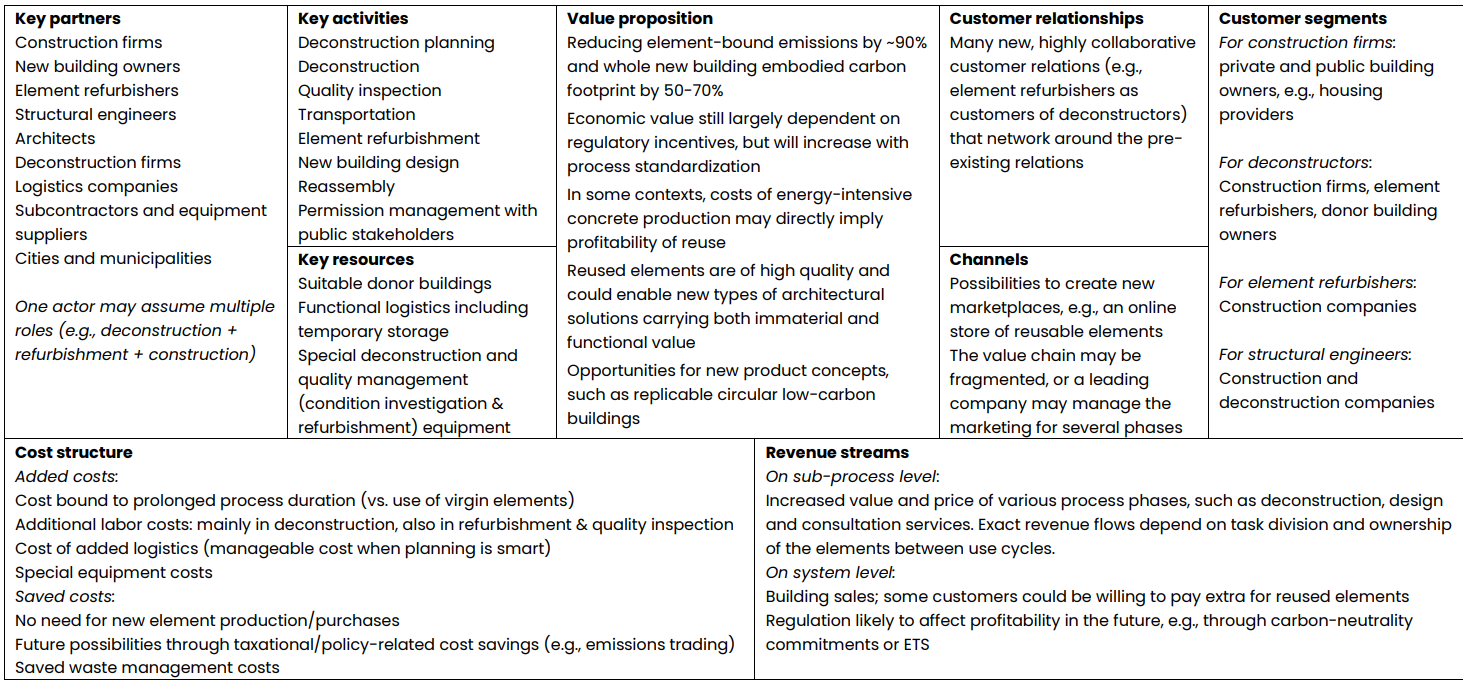
All the BMCs are published in the ReCreate project as Business model canvases for precast concrete element reuse and can be found through the project webpage.