

Author: Satu Huuhka, Tampere University
ReCreate’s Finnish cluster shares news about its new mini-pilots. This is the second of them. You can read about the first one here. Stay tuned for more info on the third mini-pilot, which will follow shortly!
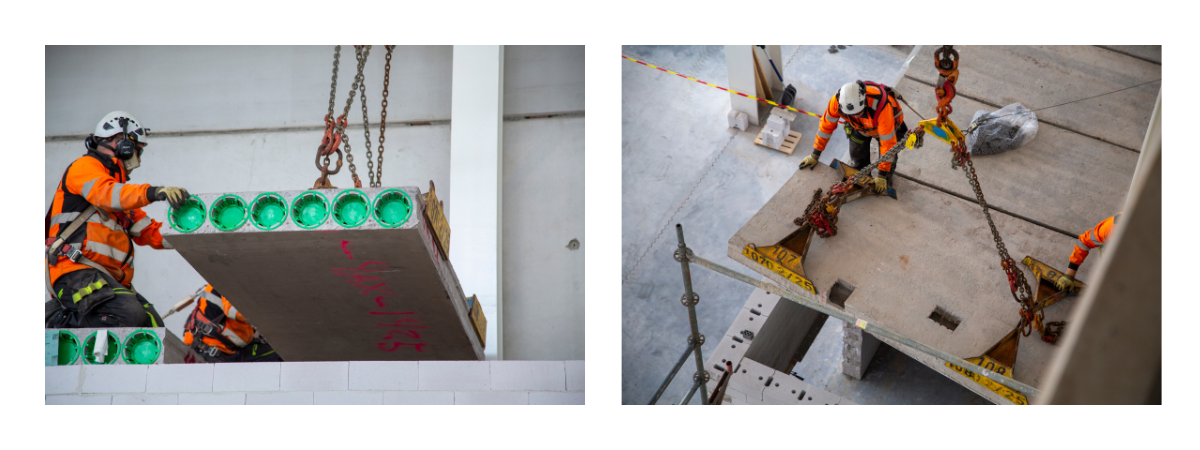
The second Finnish mini-pilot was implemented in summer 2025 in conjunction with the construction of the industrial production complex ‘Lokomotion Technology Centre’, which Skanska is building for the client Metso in the Lahdesjärvi district of Tampere. It involved reusing 27 hollow-core slabs in two buildings: a small self-standing building with technical spaces, and staff facilities located as ‘space within a space’ inside a larger industrial hall.
As opposed to the first mini-pilot where the elements were reused in intermediate floors, here the hollow-core slabs were employed in roofs. A different application of the same type of elements contributed to new learnings, as different requirements can posed on elements depending on where and how they are used, for example with regard to surface smoothness or outwardly appearance. In addition, different construction projects can have individual processual requirements for how the reuse is integrated as a part of the whole with elements made of virgin materials, regarding e.g. the assembly order and suitable assembly equipment. Organising logistics is another consideration when reused and virgin elements come from different suppliers, though this is not essentially different from regular building projects, which can also have a large number of suppliers for various construction products.
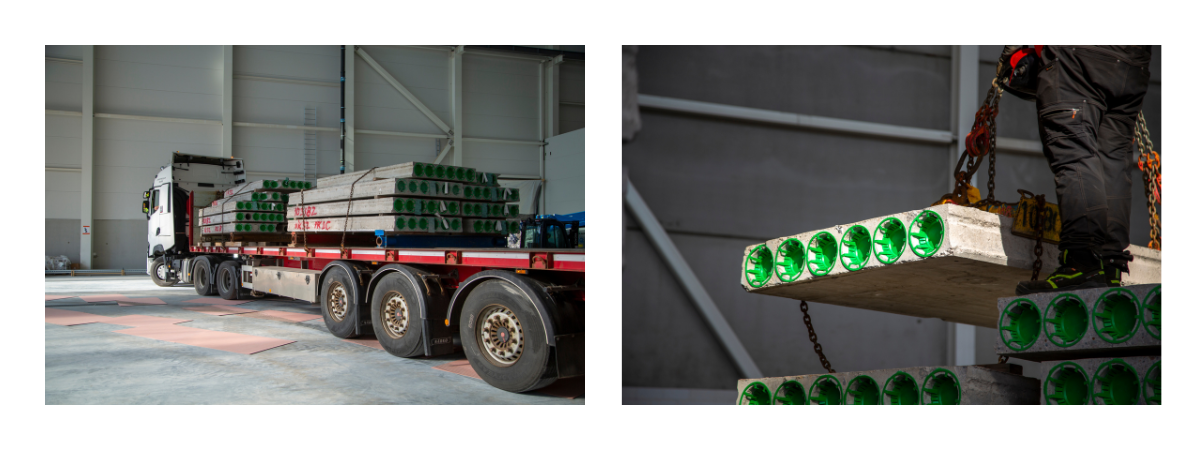
Like all elements in ReCreate’s Finnish reuse pilots, also the ones used in the second mini-pilot originated from the same donor building in Tampere city centre, originally built in the early 1980s and deconstructed by the ReCreate partners in autumn 2023. The distance between the original donor building site and the reuse site in Lahdesjärvi is 7 km.
Before reuse, the elements were refurbished by Consolis Parma. The ‘economy of scale’ of the second and third mini-pilots, together with the commercial reuse project that occurred in parallel, enabled Parma to temporarily dedicate a factory line in Nummela for the refurbishment of reclaimed hollow-core slabs. This helped to improve the efficiency of the refurbishment process, as opposed to the more customised approach of the first mini-pilot.
Ramboll Finland acted as the structural designer, responsible for all structural engineering aspects of the reuse in this pilot, including all the documentation for a site-specific approval process. The first mini-pilot set the foundations for how to conduct the approval process with the local building inspection authorities, and it was replicated in this pilot.
The mini-pilot successfully showcased the viability of reused elements in industrial buildings and as a part of a particularly complex and extensive construction project.
ReCreate’s Finnish cluster is formed by Tampere University, Skanska, Consolis Parma, Ramboll Finland, Umacon, LIIKE architects, and the City of Tampere.
Video & photo credit: Creamframe / Mikko Laaksonen