
digital workflow - Recreate

July 13, 2026
Arianna-Fonsati-Arlind-Dervishaj-Kjartan-Gudmundsson.jpg

Authors: Arianna Fonsati, Arlind Dervishaj and Kjartan Gudmundsson

Department of Civil and Architectural Engineering, KTH Royal Institute of Technology, Stockholm, Sweden

The transition toward a circular economy in the construction sector requires reliable methods for documenting, verifying, and exchanging information about reusable building components. While the reuse of structural elements, such as precast concrete slabs, can significantly reduce embodied carbon emissions and construction waste, its large-scale adoption is often hindered by insufficient and inconsistent information on component quality, performance, and compliance.

This study investigates how openBIM standards can support digital validation processes for reusable building components. Specifically, it explores the use of the Information Delivery Specification (IDS), a buildingSMART standard, to automate validation of Industry Foundation Classes (IFC) models representing precast hollow-core slabs intended for reuse. The methodology is tested against the Norwegian standard NS 3682:2022, which defines quality assurance requirements for the reuse of hollow core slabs.
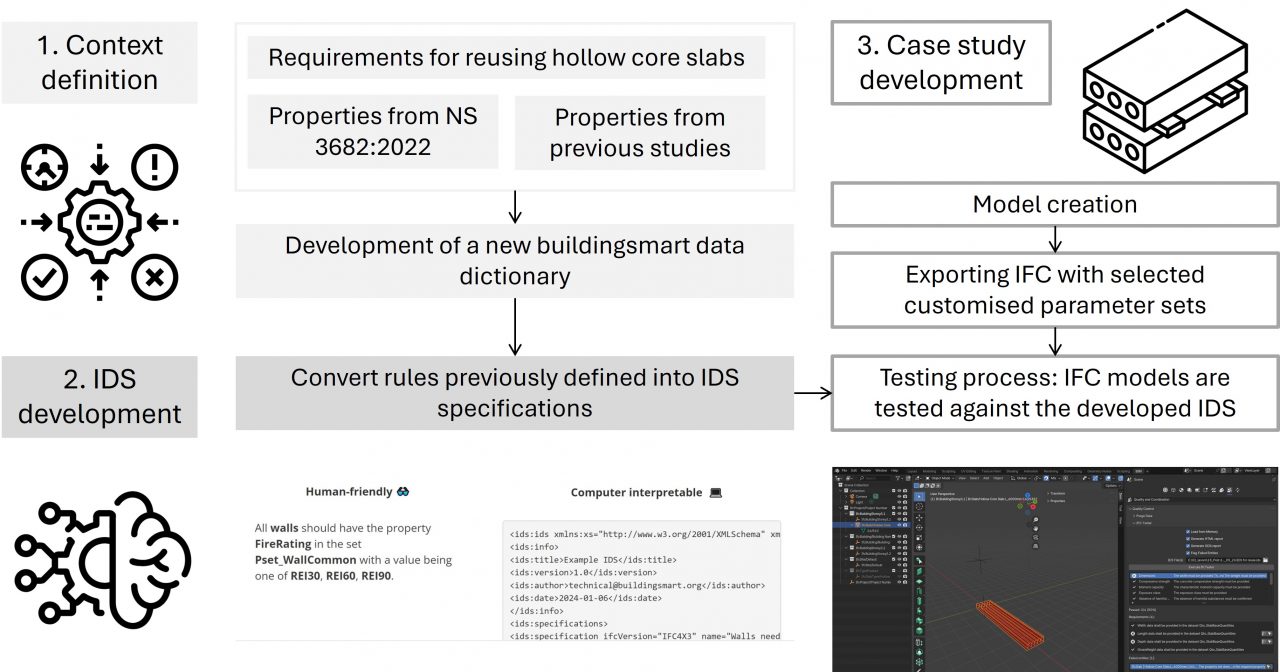
Figure 1: Approach involving three main steps

The proposed approach consists of three main steps (Figure 1). First, information requirements for reusable slabs are identified from NS 3682:2022 and complementary research. These requirements include geometric characteristics, structural properties, durability indicators, manufacturer information, and verification records. Second, the requirements are translated into machine-readable IDS specifications linked to IFC entities and standardised through a dedicated buildingSMART Data Dictionary (bsDD). Finally, the resulting IDS is applied to an IFC model of a hollow core slab to automatically assess compliance. A case study was developed in Autodesk Revit to create an IFC4x3 model of a hollow-core slab. Validation was carried out using the open-source Bonsai add-on for Blender. The results demonstrate that IDS effectively verifies the presence and structure of required information within IFC models. The validation process successfully identified missing or incorrectly mapped properties, enabling users to quickly detect data quality issues and improve model consistency.
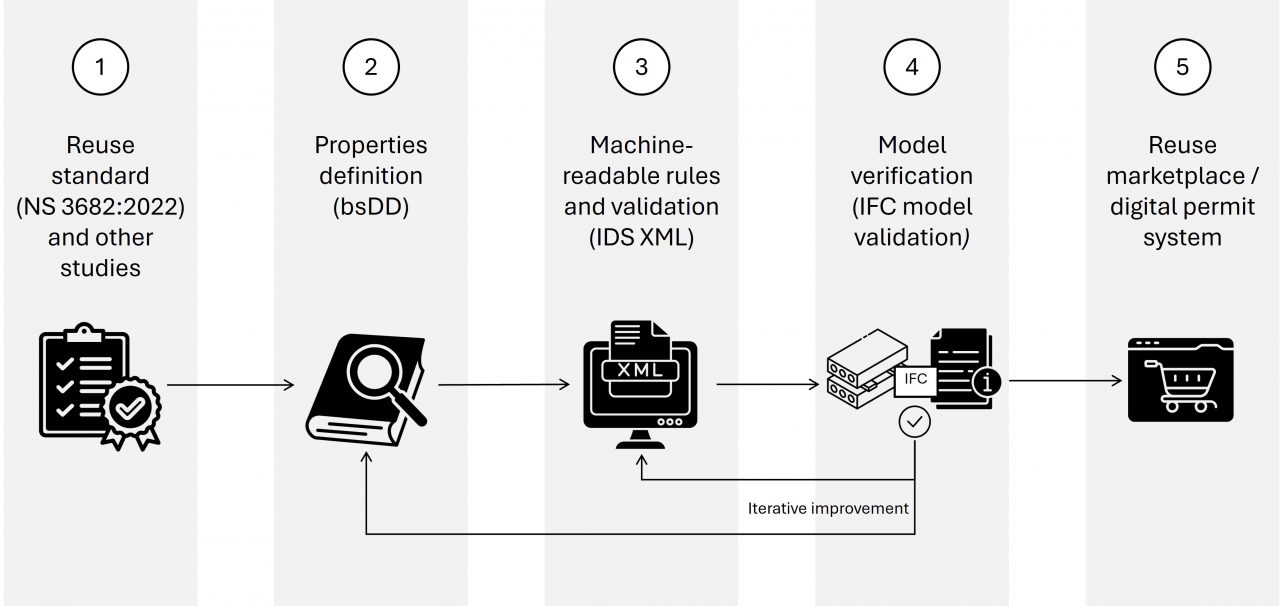
Figure 2: Conceptual workflow connecting bsDD, IDS and IFC validation for reuse

Figure 2 shows the proposed digital workflow for validating reusable building components through openBIM standards, connecting bsDD, IDS, and IFC standards. The bsDD provides semantically consistent property definitions, IDS translates these requirements into validation rules, and IFC serves as the container for the digital representation of the building component. Together, these standards create a transparent and interoperable workflow that can support digital inventories and online marketplaces for reclaimed construction products.

The study also highlights several limitations. IDS can verify whether required information is present but cannot assess the accuracy or reliability of the underlying data. Physical inspections, testing procedures, and expert judgment therefore remain essential components of reuse assessment. Furthermore, the successful implementation of IDS depends on stakeholders’ digital capabilities and the quality of IFC models, which may present challenges for smaller organisations.

Despite these limitations, the research demonstrates that IDS is a promising tool for advancing digital validation in circular construction. By translating human-readable reuse requirements into machine-readable rules, the approach improves transparency, interoperability, and trust in reuse processes. Beyond hollow core slabs, the methodology could be extended to other building components and integrated into digital marketplaces, material passports, and regulatory compliance systems. Ultimately, the framework contributes to a more data-driven and sustainable management of building materials, supporting the broader transition toward a circular built environment.



March 11, 2026
Arlind-Dervishaj-1280x670.jpg

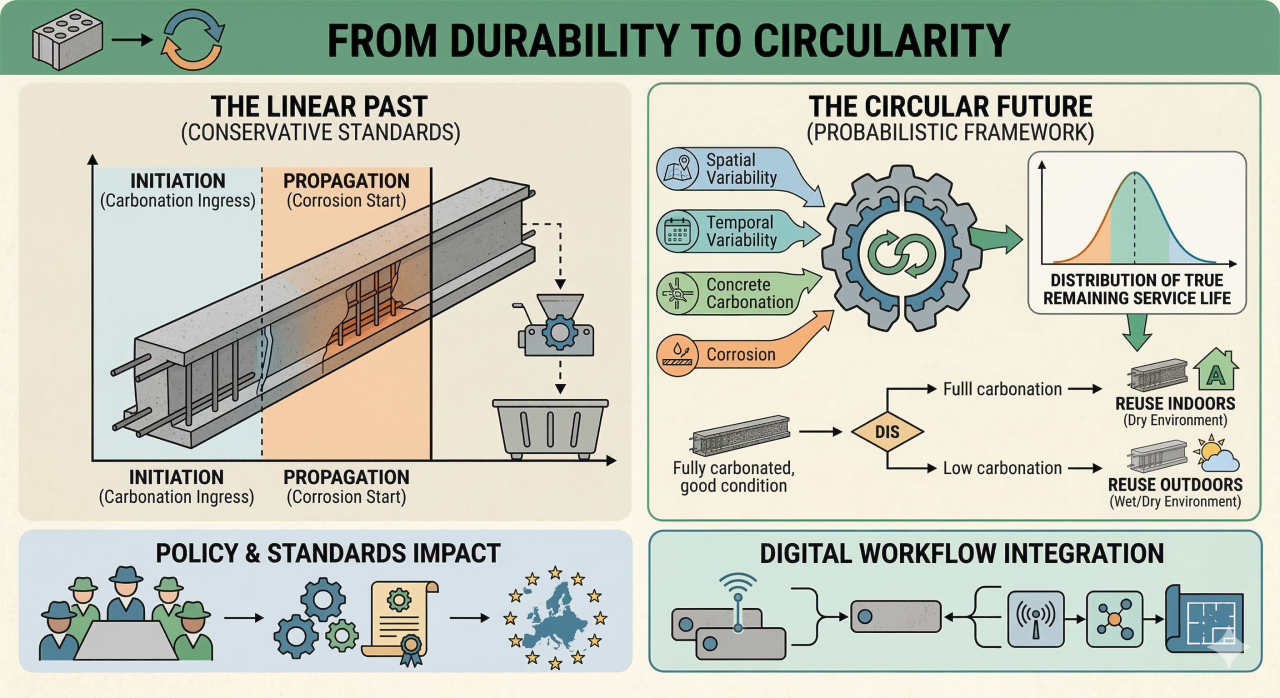
Ensuring the service life of reused concrete components is a critical requirement for safe reuse, but it is also the key to accurately evaluating the true reuse potential of existing elements. Currently, the construction industry faces a major regulatory roadblock: standards typically limit service life strictly to carbonation (corrosion initiation phase: when carbonation reaches the reinforcement). In practice, this approach is conservative and can prematurely disqualify otherwise viable elements. Meanwhile, most durability research focuses on the corrosion propagation phase of new low-carbon cements, leaving a massive blind spot that completely overlooks the service life for the reuse of existing concrete. 

 To overcome this barrier, our latest study establishes a probabilistic performance-based framework for reliably predicting the remaining service life of concrete [1]. Rather than relying on rigid, deterministic calculations of expiration dates, this framework integrates both the initiation and propagation phases of corrosion. It relies on a Monte Carlo simulation method to estimate the probabilistic distribution of a component’s lifespan, effectively accounting for the spatial and temporal variability of concrete carbonation and corrosion in the real world. 

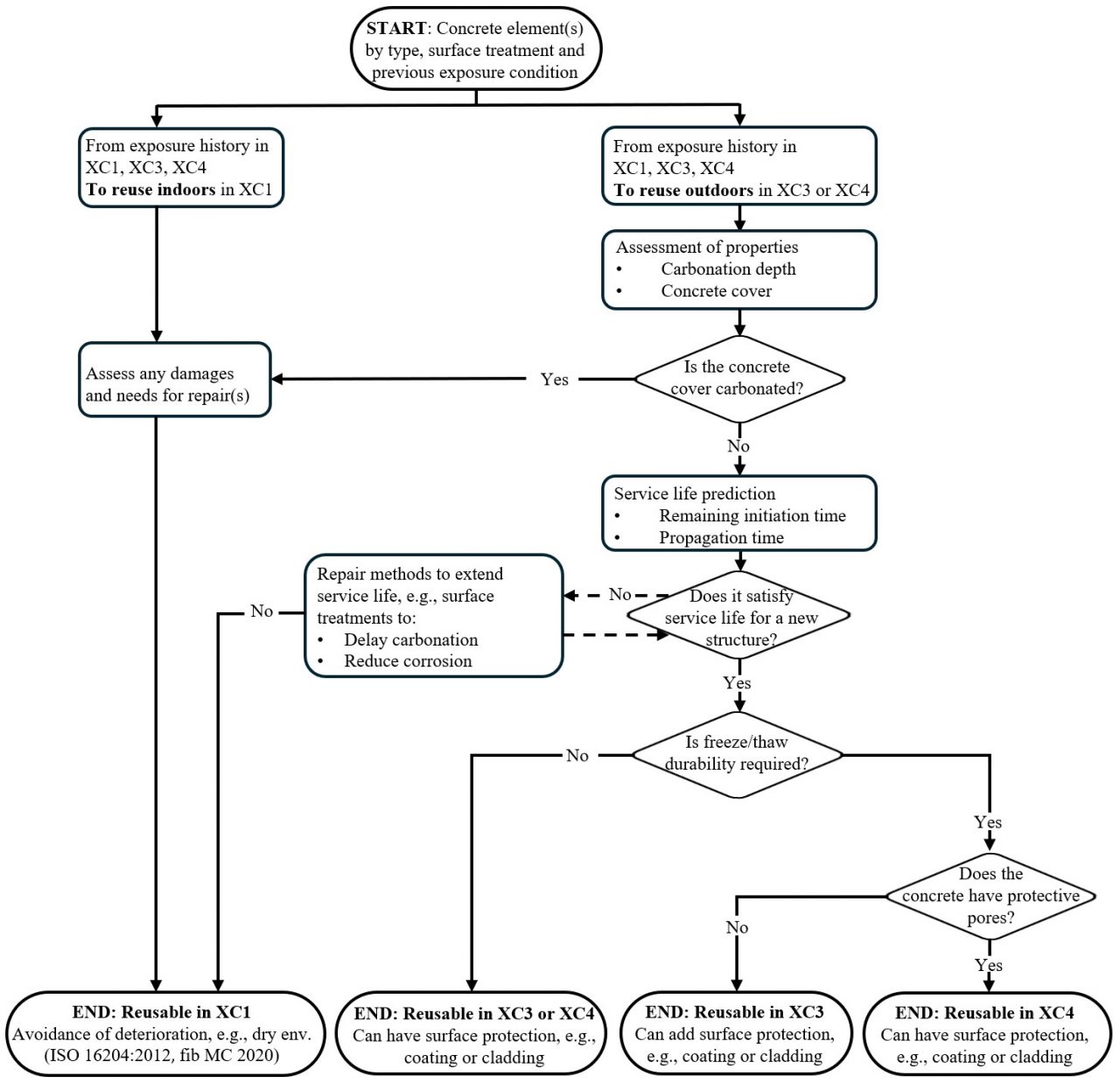
For industry practitioners, the study provides a practical decision-making flowchart to ensure service life and safe reuse based on specific exposure classes for carbonation-induced corrosion. Service life verification can be aligned with the exposure conditions of the second life. For example, if an element is fully carbonated and deemed insufficient for outdoor reuse due to a high risk of corrosion, it does not have to be crushed into waste. Because corrosion levels are negligible in dry environments, elements that are carbonated but in good structural condition can be safely reused indoors in dry environments (e.g., XC1 exposure). 

 This research has profound relevance for future policy and standardization. There is an urgent need to update standards to consider the propagation phase and acknowledge that early micro-cracking from onset of corrosion does not necessarily lower structural capacity, allowing elements to safely meet service life targets for new structures. Incorporating the propagation phase into service life assessment would allow standards to move beyond overly conservative initiation-based limits, accounting also for proactive repair and refurbishment methods for reuse [2]. Driving this change, authors Arlind Dervishaj and Kjartan Gudmundsson are active members of the Swedish standardization committee SIS TK 191 AG2. This committee is working to expand standardized reuse guidance to all precast concrete products—moving beyond Norway’s NS 3682:2022, which currently only addresses hollow core slabs. This work is paving the way for a comprehensive pan-European standard. 

 Finally, this durability assessment method does not exist in isolation. It can be directly implemented into the digital workflows proposed in our previous work. This includes: 

  • Tracking and tracing workflows using digital tags, ensuring we know exactly which element is which across the entire reuse process, from deconstruction to reuse [3–7]. 
  • Integrated digital tools to estimate the remaining service life of donor buildings for safe integration into new structures [1,8–10]. 
  • Digital workflows for estimating CO₂ uptake and embodied carbon emissions, where accurate carbonation depth is a crucial parameter for lifecycle calculations [8,9]. 

 By bridging durability modelling, digital workflows, and circular construction strategies, this research helps move concrete reuse from experimental pilots toward a reliable and scalable practice, enabling the built environment to transition confidently from a linear economy toward a fully circular one. 


References 

[1] Dervishaj A, Räsänen A, Gudmundsson K, Lahdensivu J. From durability to circularity: ensuring service life and enabling reuse of concrete in circular construction. Mater Struct 2026;59:28

[2] Dervishaj A, Gudmundsson K. From Precast Structures to reusable components: Processing and reconditioning of reclaimed precast concrete elements. In: Huuhka S, editor. Proceedings of the 2nd International Conference on Circularity in the Built Environment (CiBEn2025), Tampere: Tampere Univeristy; 2025, p. 179–179. 

[3] Dervishaj A, Gudmundsson K. Common Data Environment development for reuse. Stockholm: 2023. 

[4] Dervishaj A, Gudmundsson K. Smart Logistics for Reuse: Tracking precast concrete in Circular Construction. In: Huuhka S, editor. Proceedings of the 2nd International Conference on Circularity in the Built Environment (CiBEn2025), Tampere: Tampere University; 2025, p. 92–92. 

[5] Dervishaj A, Hernández Vargas J, Gudmundsson K. Enabling reuse of prefabricated concrete components through multiple tracking technologies and digital twins. European Conference on Computing in Construction and the 40th International CIB W78 Conference, vol. 4, Heraklion: European Council on Computing in Construction; 2023, p. 1–8. 

[6] Dervishaj A, Fonsati A, Hernández Vargas J, Gudmundsson K. Modelling Precast Concrete for a Circular Economy in the Built Environment: Level of Information Need guidelines for digital design and collaboration. In: Dokonal W, Hirschberg U, Wurzer G, editors. Proceedings of the International Conference on Education and Research in Computer Aided Architectural Design in Europe, vol. 2, Graz: Education and research in Computer Aided Architectural Design in Europe; 2023, p. 177–86. 

[7] Elshani D, Dervishaj A, Hernández D, Gudmundsson K, Staab S, Wortmann T. An Ontology for the Reuse and Tracking of Prefabricated Building Components. Extended Semantic Web Conference: The second international Workshop on Knowledge Graphs for Sustainability – KG4S, 2024. 

[8] Dervishaj A, Gudmundsson K, Malmqvist T. Digital workflow to support the reuse of precast concrete and estimate the climate benefit. IOP Conf Ser Earth Environ Sci 2024;1402:012026. 

[9] Dervishaj A, Malmqvist T, Silfwerbrand J, Gudmundsson K. A digital workflow for assessing lifespan, carbonation, and embodied carbon of reusing concrete in buildings. Journal of Building Engineering 2024;96:110536. 

[10] Dervishaj A, Gudmundsson K. From LCA to circular design: A comparative study of digital tools for the built environment. Resour Conserv Recycl 2024;200:107291. 


EU FUNDING

“This project has received funding from the European Union’s Horizon 2020 research and innovation programme under grant agreement No 958200”.

Follow us: