

José Hernández Vargas
KTH Royal Institute of Technology
The extensive use of concrete stands as one of the most pressing environmental challenges in the construction sector. Its combination of mechanical performance, availability, and low cost has made it the most widely used building material worldwide, with no viable substitute available at a comparable scale. This doctoral research examines how digital design and fabrication technologies can reduce this impact, with a focus on extrusion-based 3D concrete printing (3DCP). The work is presented as a compilation of an introductory summary and six appended papers. Although the technology has advanced rapidly over the last decade, methods for fully exploiting its design potential remain largely underdeveloped, since most workflows assume a separation between the design process and the generation of manufacturing instructions. The question guiding this work is therefore which design possibilities the process affords and how they can be directed towards structural and environmental performance.
Within the ReCreate project, this research has contributed to digital methods for reusing precast concrete elements, including classification taxonomies, structured element databases, and BIM-based workflows. These developments translate the knowledge embedded in historical precast systems into standardised digital formats that can be integrated into contemporary design practice. However, reclaimed elements are found in limited supply, with fixed dimensions, predetermined openings, and properties defined by their first service life. Reuse alone cannot answer every condition of a new project. This gap motivates the consideration of 3DCP as a complementary technology for circularity in the built environment.
Design freedom directed towards performance
3DCP deposits fresh concrete through layer-by-layer extrusion following a digital model, removing the need for formwork. As a consequence, manufacturing cost is largely decoupled from geometric complexity, and an intricate object can use less material than a solid cast element. This freedom of shape is here directed towards structural performance rather than formal expression. The paper on internal topology optimisation presents a method in which the print path and filament width are dynamically adapted to the expected stress distribution while preserving the external boundaries of the element. The results demonstrate improvements in strength-to-weight ratio ranging from 47 to 63% compared with a conventionally printed beam. These findings indicate that the inherent complexity of the process can translate directly into measurable material savings.
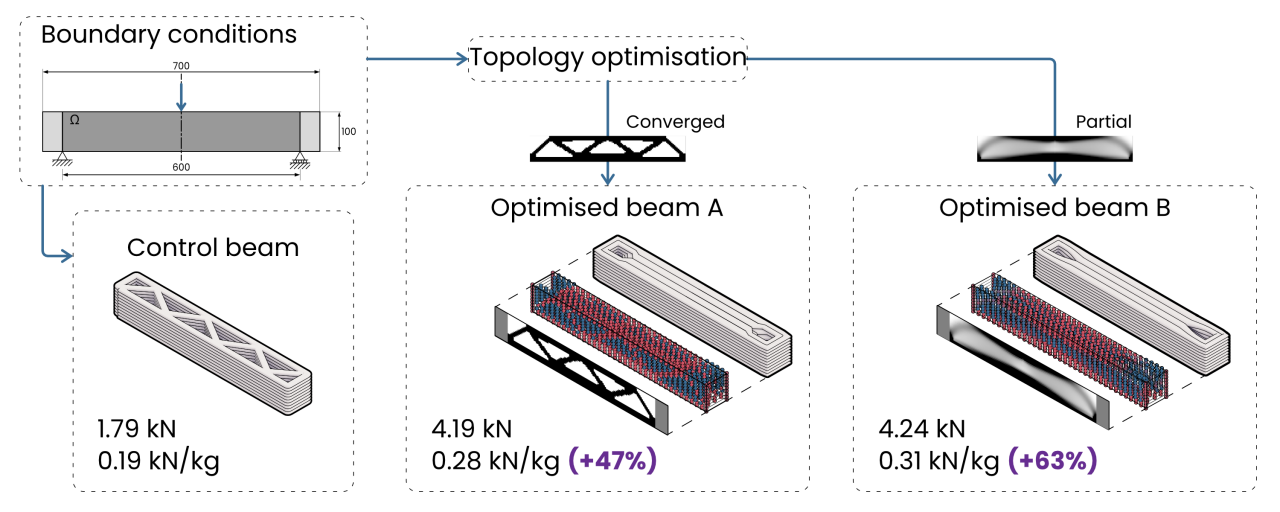
Beams with internally optimised print paths sustained substantially higher maximum loads than the control specimens, showing that adapting the infill to the stress distribution converts geometric complexity into structural capacity.
Circular hybrid façades
The paper on circular hybrid façades applies these capabilities to the reuse of concrete elements directly. It presents 3DCP as a circular retrofit strategy in which thermally optimised outer skins are printed and fitted onto reclaimed load-bearing elements, upgrading their performance. Because each skin is generated from a digital model, its geometry can respond to the specific dimensions of the donor element and to the thermal requirements of its new location. One-off, project-specific components thus become economically plausible. This approach suggests a productive division of labour between the two technologies, in which reuse retains the structural mass already cast while printing supplies the differentiated, performance-critical layer around it.
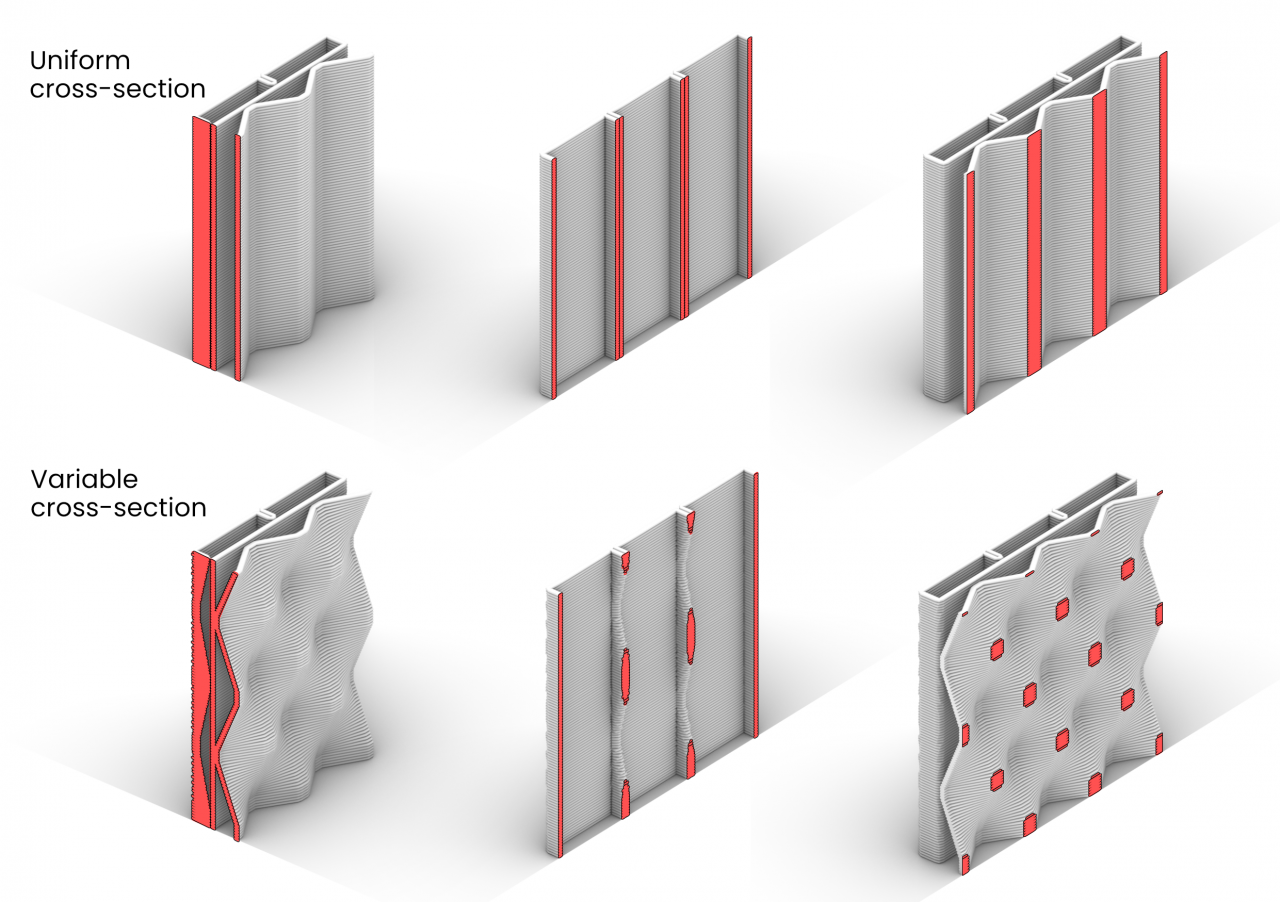
Internal structure of a variable cross-section façade component, showing alternated printed cavities and limiting the contact area, thus minimising thermal transmittance.
Reuse and 3DCP therefore address the same problem from opposite ends. The former extends the service life of material that has already been cast, whereas the latter ensures that new material is deposited only where it is structurally required. Both strategies depend on the same digital infrastructure of classification, parametric modelling, and fabrication-aware design. It remains to be seen how far these methods can scale, yet together they point towards a construction culture in which existing and printed concrete are designed as parts of the same circular value chain.
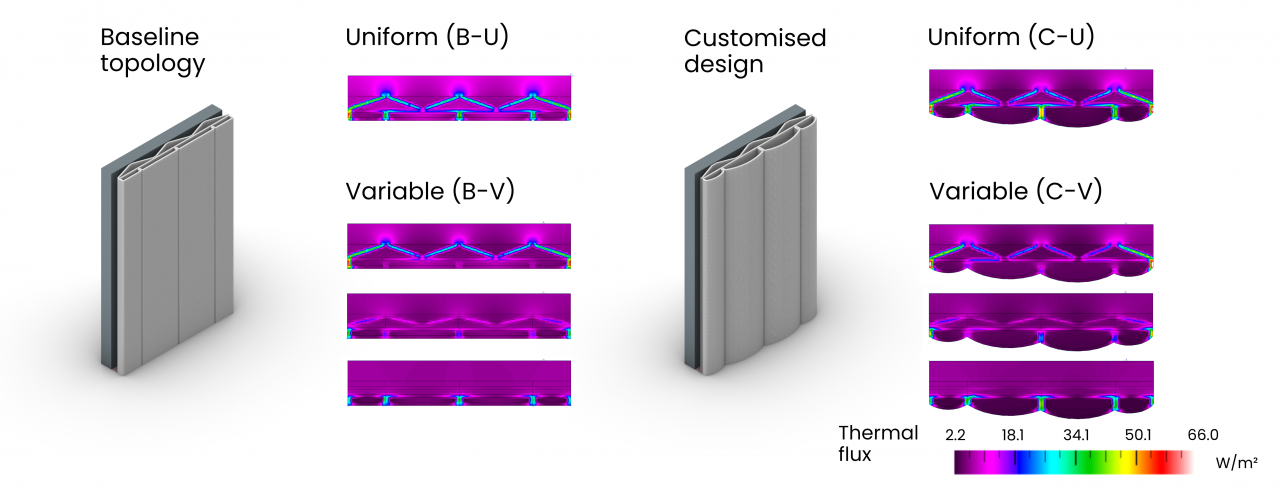
Comparison of continuous and variable printed sections with their corresponding calculated U values.