

Authors:
Agnese Scalbi, Eindhoven University of Technology
Marcel Vullings, TNO
ReCreate’s Dutch cluster reflects on the need for quality assurance and supportive regulation from a business point of view.
Reusing precast concrete structural elements can substantially reduce environmental impacts and resource consumption in the built environment. For precast concrete, however, reuse only becomes viable at scale when quality can be demonstrated as clearly as it is for new products.
Why quality assurance is a bottleneck
Reusing structural components requires attention to structural safety, durability, and compliance with design requirements. Reclaimed elements may show material degradation, unknown loading history, and variable exposure conditions, and they often come with incomplete documentation. In many cases, key material properties such as the compressive strength of concrete are also unknown and must be determined to enable proper re-engineering of the reclaimed structures. Because most building codes and standards are written for new components, they presently offer limited practical guidance on how to qualify reclaimed precast elements. The lack of harmonised frameworks and industry-wide protocols remains a major barrier. Bridging this gap means developing a reuse-oriented verification workflow that extends current established certification approach for new elements into a clear, robust and repeatable procedure for reclaimed precast elements.
Research confirms that current quality assessment practices for reclaimed elements are still fragmented. Many projects rely on case-by-case evaluations, tailored to local expertise and constraints. ReCreate pilot projects have highlighted the recurring challenges observed during deconstruction, transport, and storage. Typical uncertainties include incomplete original specifications, potential damage accumulated in service, and the influence of storage conditions, all of which could affect reuse feasibility. The pilots make it clear that scalable reuse needs consistent procedures covering the whole value chain: from inspection and testing to classification and integration into new designs.
What needs to be checked (and why it is not straightforward)
Technically, reclaimed precast elements must be checked for geometry and tolerances, material properties, reinforcement or prestressing conditions, and cracks or other defects. This typically requires a staged combination of non-destructive, semi-destructive, and destructive tests.
A key challenge is choosing the right level of testing when the original documentation and use history are incomplete. Without clear decision rules, projects risk either over-testing (higher cost and waste) or under-testing (reduced confidence and safety). An additional challenge is determining at which points testing should occur, since reuse spans several phases, from dismantling and transport to storage, refurbishment, subsequent transport, and reassembly. During these phases, the condition of elements can change. While certain properties, such as concrete compressive strength, are unlikely to change during this process, damage-related indicators like cracking, can evolve with each handling step. This makes it essential to align testing and inspection moments with critical points along the value chain.
Digital tools: high potential still developing
Digital tools could help close these gaps. Digital product passports and shared databases can support traceability, standardised data exchange, and faster decision-making across the value chain. However, robust processes for creating, populating, and maintaining reliable data for reclaimed elements are still developing.
TU/e quality assurance framework
Within ReCreate’s procedure for quality management of reclaimed concrete elements, TU/e research focuses on damage and quality assurance investigations in the Netherlands and the development of an assessment framework that specifically addresses the requirements of the Dutch pilot project. The framework moves on in line with ReCreate’s overall recommendations for quality management, maintaining the link between the knowledge levels and the required checks and tests, while remaining coherent with regulatory expectations. Due to the element stock available from the selected donor building in the Netherlands, the approach was initially developed for hollow core slabs (HCS), and it was streamlined as follows:
- Knowledge assessment: collect available documentation and data (from producers, design documents, and/or previous testing).
- Damage evaluation: identify and classify damage from use, dismantling, transport, and storage through inspection.
- Structural reliability: determine material properties of elements and evaluate load-bearing capacity for the intended new application, supported by analysis and targeted testing.
- Aesthetic checks: screen and assess visual acceptability.
To support consistent implementation, TU/e has developed an HCS damage catalogue and an inspection checklist for operators and engineers, respectively, inspecting elements on site and during refurbishment, together with a classification system that groups elements by required intervention (installation-ready, maintenance/repair needed, or further testing). A second classification describes reuse potential (full-capacity or an easier application, e.g. reuse is allowed with revised design performance related to capacity, span, exposure class or reliability level). Finally, quality records (e.g. tests, certificates, documentation) linked to elements’ digital identification will complete the Element Database System (e.g. ReCreate Studio Database), where assessed data should be accessible to different stakeholders, such as manufacturers, designers, and builders, who can find, compare, and specify reclaimed elements with confidence.
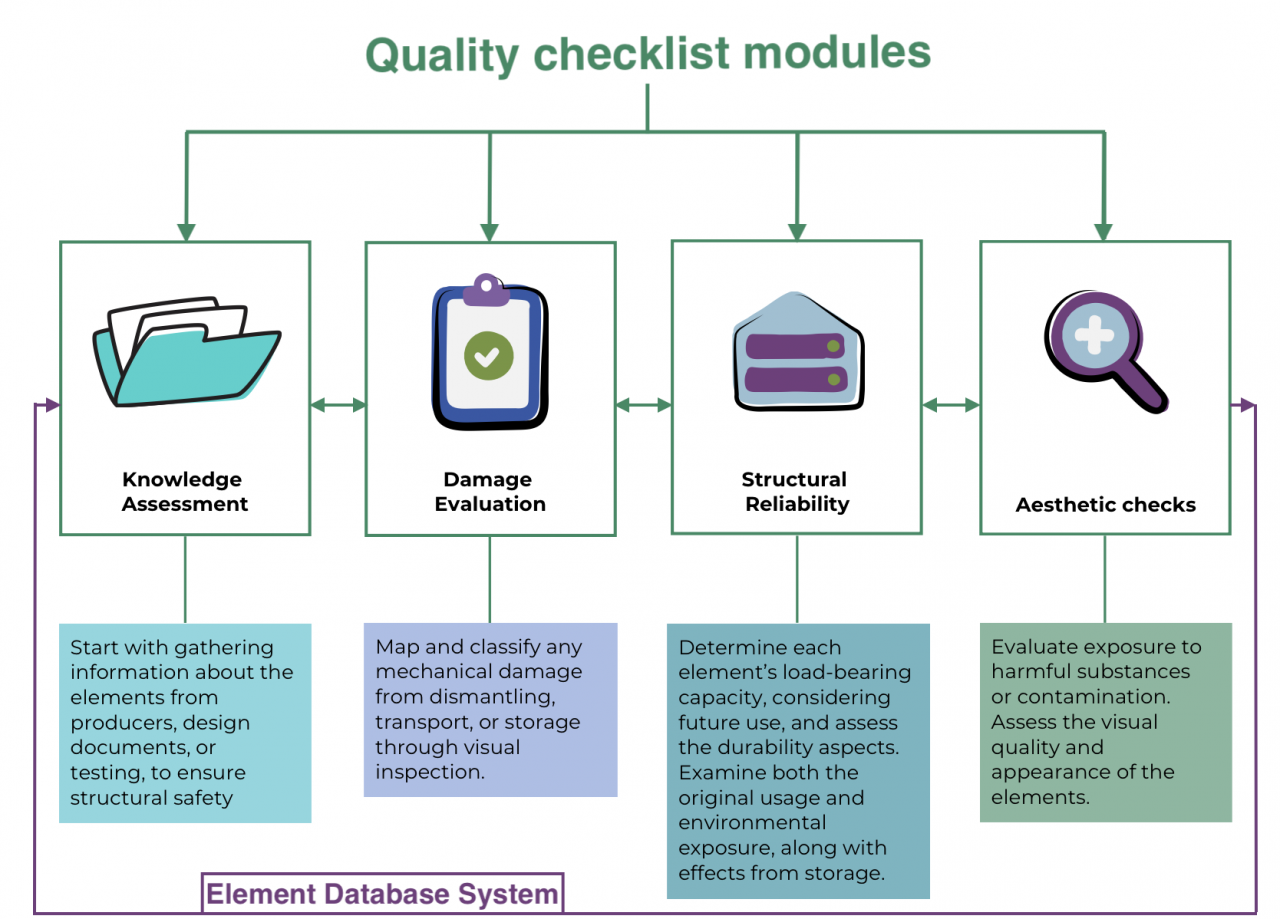
Figure 1. Quality check framework for evaluating the reuse of reclaimed elements. Figure by Agnese Scalbi.