
Author: Jakob Fischer, Brandenburg University of Technology
Building on Episode 1 (The tendering procedure for the pilot project in Germany – Part 1: The competition), this blog post explains the Specification for the “Youth Centre at Sternentor” and outlines selected bidder questions that were received during the four-week publication period and answered by the client (the City of Hohenmölsen).
Specification (Part B)
The specification explains to the bidders the construction project on the basis of key information and basic requirements, along with the attached annexes. The annexes include the exposé already prepared by the BTU (Head of German ReCreate Cluster) as well as initial design documents. The approved development plan was provided by the City of Hohenmölsen (ReCreate partner and client for the construction project).
As in the procedural conditions (Part A) – described in the first episode of the blog series – the Specification (Part B) also take into account the necessary reference to the reuse of used concrete components. The specification is divided into 12 chapters (A to L). These are explained below:
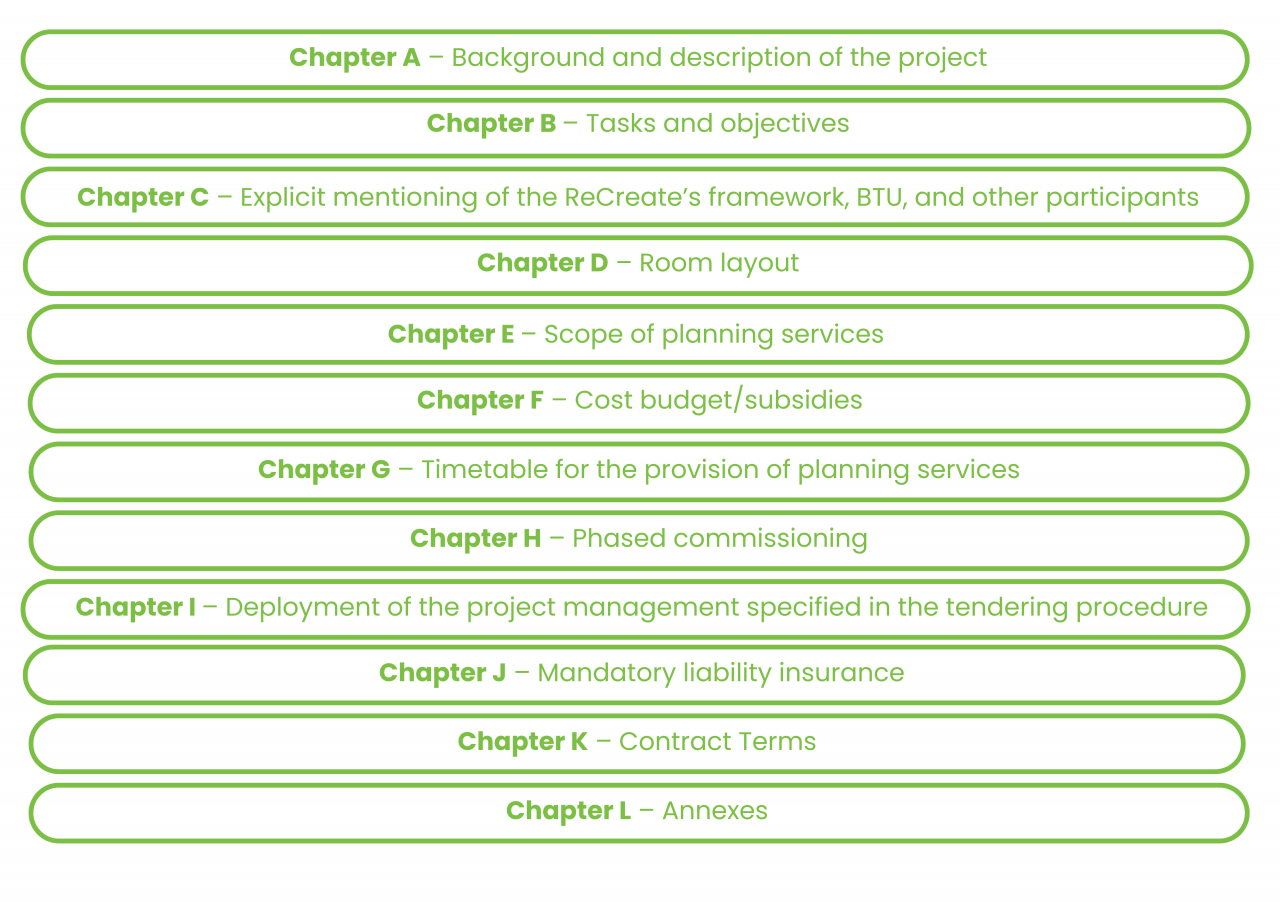
Chapter A (background and description of the project) provides bidders with an introduction to the construction project, the background to the need for the new building, and the necessary reference to sustainability. Accordingly, emphasis is to be placed on an “energy-efficient building design, the use of recycled and sustainable building materials, climate friendliness and a low carbon footprint“. In addition, the construction project should “ideally demonstrate the feasibility of climate-friendly and resource-efficient construction in the public sector“.
Chapter B (tasks and objectives) deals with the special requirements, local conditions and structural design. From the outset, the conditions for reusing the reinforced concrete components from the demolition project in Höhenmölsen, which are already stored in temporary storage, are clarified. Proof of fire protection and structural stability is still required, as well as compliance with current energy efficiency building guidelines. As the reuse of used concrete components is not yet widely practised, a section of the specification outlines the significance from an ecological and economic perspective. The bidder/bidding consortium is provided with initial basic facts about the circular construction, such as the avoidance of manufacturing energy and CO2e-emissions by over 90%, the relief of limited landfill capacities, and verifiable cost savings in shell construction.
An essential component is the explicit mentioning of BTU Cottbus-Senftenberg as scientific support within the framework of the European research project ReCreate, as well as other participants explained in Chapter C.
The room layout is specified in Chapter D and supplemented by the attached exposé. The building is to cover a total of 835 m² (according to the draft plans).
The scope of planning services (Chapter E) reveals a significant difference compared to other planning services. As the advanced ReCreate project has already accomplished initial investigations, discussions, agreements and designs, the project is not entirely at the beginning stage but is already in service phase 3 according to HOAI (Honorarordnung für Architekten und Ingenieure; translation: “Schedule of Services and Fees for Architects and Engineers). This means that the bidder/consortium does not have to offer any fundamental changes or new designs for the cubature, use and room layout.
Chapter F (Cost budget/subsidies) explains the planned use of subsidies from the “New European Bauhaus” (NEB) programme and the planning and time requirements for the approval of subsidies. At the time of the tender, the subsidies have been reserved at the Investment Bank of Saxony-Anhalt and can be released on condition that a complete design plan has been reviewed. Furthermore, in order to receive funding, it must be ensured that all work on the construction project is completed by mid-2027.
Chapter G (Timetable for the provision of planning services) and Chapter H ( Phased commissioning) clarify which service phases are to be performed within which time frame. The services in service phases 3 (design planning) and 4 (approval planning) must be completed by January 2026 at the latest, so that implementation planning (service phase 5), tendering and awarding of construction contracts (service phases 6 and 7) can then begin. The shell construction (part of service phase 8) is therefore scheduled for the third quarter of 2026. The commissioning of the aforementioned service phases is at the discretion of the client and will be carried out in stages, i.e. at different times and, if necessary, with additional/new contractors. At present, the above-mentioned service phases are divided into three service levels, i.e. commissioning in stages.
The framework conditions for the deployment of the project management specified in the tendering procedure are explained in Chapter I and the mandatory liability insurance in Chapter J. The project management may not be replaced without justifiable reasons or without the consent of the client (City of Hohenmölsen). This requirement is intended to ensure continuous communication with the responsible project management. Furthermore, the bidder/consortium must provide proof of liability insurance covering personal injury up to €3 million and property damage and financial loss up to €1 million.
Chapter K (Contract Terms) and Chapter L (Annexes) refer to the attached and additional tender documents.
“The individual chapters of the Specification (Part B) show that the scope and conditions for participation in the present tender process differ only marginally from tenders in which the reuse of used concrete components is not the subject of the planning and contract. The more often this fact and the minor hurdles or differences become apparent, especially to the contracting authorities and clients, the sooner we will see widespread reuse practices.”
Bidder questionnaire
The list of bidder questions is an important component of the public tender as a means of communication between bidders/consortia and the client (the City of Hohenmölsen). A total of 18 questions regarding the tender documents were received during the four-week publication period. Selected questions and answers are outlined below:
There were frequent questions as to whether the restriction on the reuse of used concrete components could be broadened and whether, for example, experience with the reuse of steel components or the preparation of the design of construction projects using reused concrete components would suffice. These requests could not be met by the client. In the course of preparing the tender documents, it became apparent that a high level of qualification/experience on the part of the contractors with regard to the specific requirements of concrete component reuse for a construction project with strict time and monetary constraints is essential.
Another uncertainty/question was whether and to what extent the necessary services for technical building equipment, fire protection tests and further preliminary planning had already been carried out or whether corresponding concepts for processing service phase 3 were available. In response, reference was made to the “Architect and Engineer Contract – Property Planning Services” (Part C) found in the tender documents and to the fact that these services are to be provided in full in the first service stage (compare Chapters G and H).
Other bidder questions dealt with misunderstandings, interpretation issues and technical/planning concerns, all of which were answered by the client. The unresolved issues were discussed in the bidder meetings and will be clarified in a timely manner before approval in January 2026.