

Authors: Jyrki Tarpio & Tapio Kaasalainen, Tampere University
A Circular Economy Course is held for fourth– and fifth–year architecture students at Tampere University each year. In 2025, the students’ assignment was to study how to reuse load-bearing structural precast concrete elements deconstructed from an office building in new-build multifamily housing. The Finnish deconstruction pilot building of the ReCreate project, the load-bearing structural elements of which were dismantled in 2023, acted as a reference donor building in the course.
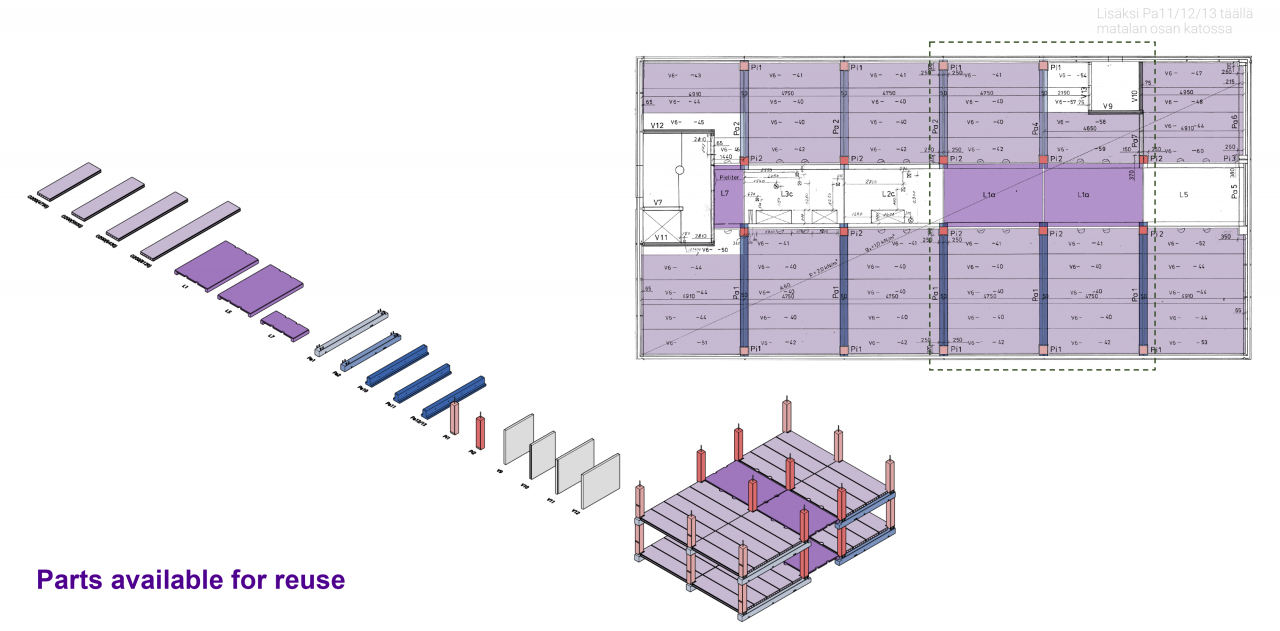
Figure 1. Load-bearing elements of the Finnish donor building. Axonometric images and floor plan of a standard floor, excluding stairs. Image: Tapio Kaasalainen (adapted from an original plan drawing by Suunnittelutieto Oy).
A combination of hollow-core floor slabs, massive concrete slabs, columns, beams, and wall elements formed the load-bearing structure of the office building. Architecture students were asked to utilise these elements, bearing in mind that hollow-core slabs can be cut shorter or narrower and massive slabs shorter, but other elements must be used in their original size. Instead of being asked to design new buildings themselves, the students were handed drawings of two recently constructed apartments buildings in Tampere. Their task was to examine how to use the reclaimed elements as the load-bearing structure of one of the two reference apartment buildings maintaining its shape, main dimensions, and housing unit allocation (i.e. size and number of apartments). The main challenge was caused by the fact that the load-bearing structure used in both reference cases consists of walls and slabs, but the students had to mainly apply a column-beam-slab structure designed for a different building type and function. The task was limited to examining one recurring floor of one reference building per a student pair. To keep the workload manageable and focused, students were instructed to apply the reference buildings’ exterior wall structures as-is, even though in reality some modifications might be needed due to the altered overall structure.
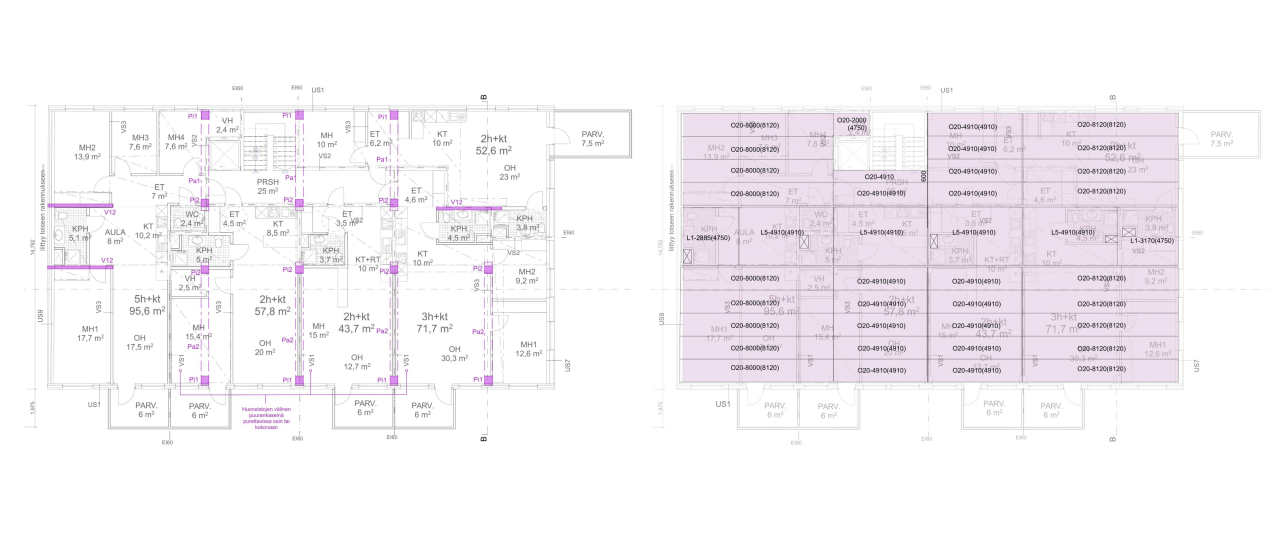
Figure 2. Reuse applied to a rectangular apartment building. Column, beam, and wall reuse (coloured parts) shown on the left, slab reuse on the right. Design and images: Helmi Haapalainen & Viola Rytkönen.
Of the two references, the case ‘rectangular apartment building’ shared basically the same building depth as the office building, but its length was shorter. This made it possible to use nearly the same structural composition in the apartment building as in the original office building. The design by students Helmi Haapalainen and Viola Rytkönen (Fig. 2) reuses most slabs in their original or nearly original length, with two massive slabs and one hollow-core slab shortened notably and one hollow-core slab cut narrower. In the design, the locations of bathrooms and WCs are slightly modified so that they are concentrated in the middle of the building on the zone consisting of massive floor slabs. This arrangement is beneficial for organising plumbing and vertical building service stacks in a cost-effective way and also allows horizontal runs ”within” the inverted-U-shaped slab. The columns and beams are generally placed so that they don’t diminish the functionality of the rooms. However, in one room there is a slight aesthetic compromise with a beam running across it in the middle.
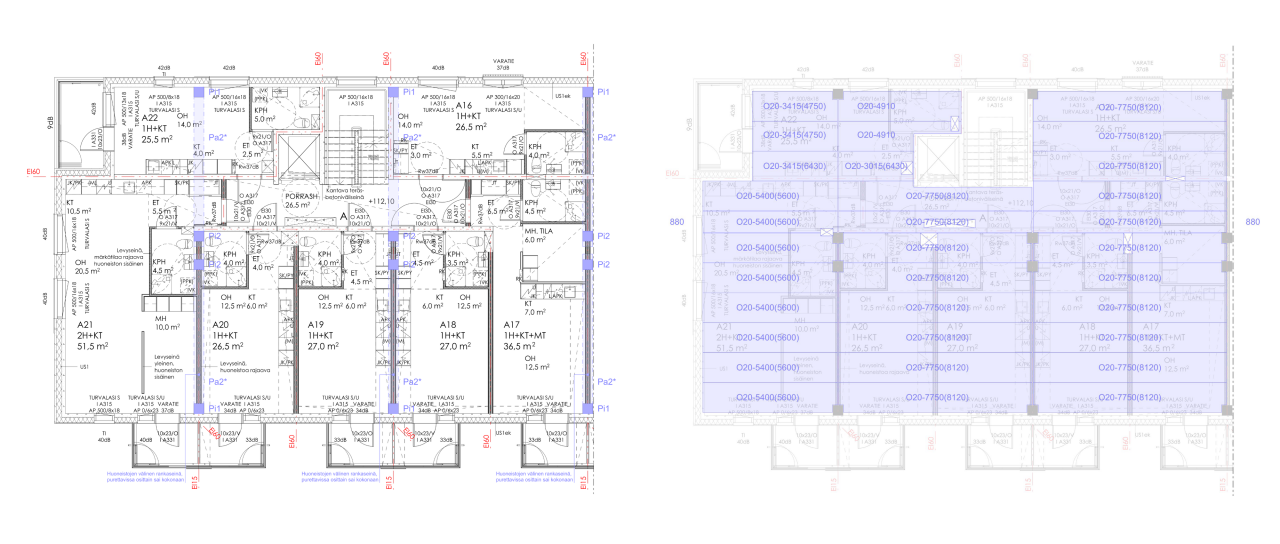
Figure 3. Reuse applied to the cut-corner apartment building. Column and beam reuse (coloured parts) on the left, slab reuse on the right. Design and images: Minttu Puustinen & Veetu Varala.
The shape and overall dimensioning of the other case, the ‘cut-corner apartment building’, was more challenging. Its frame depth is approximately one metre narrower and its length is shorter than the office building’s. However, students Minttu Puustinen and Veetu Varala proved in their design (Fig. 3) that, utilising the given columns, beams, and hollow-core slabs creatively, the load-bearing structure can be implemented successfully. They reused longer beams on both sides of the building and suggested a short new special beam in the middle of the building frame as well as shortened most hollow-core slabs—mostly cut only moderately, but some more extensively. The moderate cuts were similar in length to what might be required when salvaging some slabs in any case, although on the course all components were assumed to be as originally designed. Additionally, they narrowed one slab zone near the middle to fit the whole design into the required frame depth. With one exceptional column and beam location, they managed to fit the columns and beams along the party wall or walls separating apartments.
Concluding notions
Twelve groups of architecture students provided slightly different designs to the two reference buildings. In general, all students were able to grasp the idea of structural reuse with the notion that some additional material layers need to be installed on reused slabs and walls to meet the current soundproofing requirements of domestic spaces. As the final part of the course, the students made calculations on the embodied CO2 emissions and corresponding CO2 savings with their suggested reuse solution.
Most student designs had lower embodied emissions than the original reference buildings even without reuse (Fig. 4). This was largely due to the post and beam structure inherently reducing the amount of concrete used. Many designs also reused concrete panels from partition walls, in partition walls. These were thinner than are typically found in new construction, and thus even with added sound insulation led to lower emissions even for the ‘without reuse’ scenario which assumed virgin materials for the same structures. In contrast, however, in the same scenario a few student designs ended up exceeding the reference case’s emissions when concrete panels were used where not necessarily needed, such as under a beam along an apartment boundary.
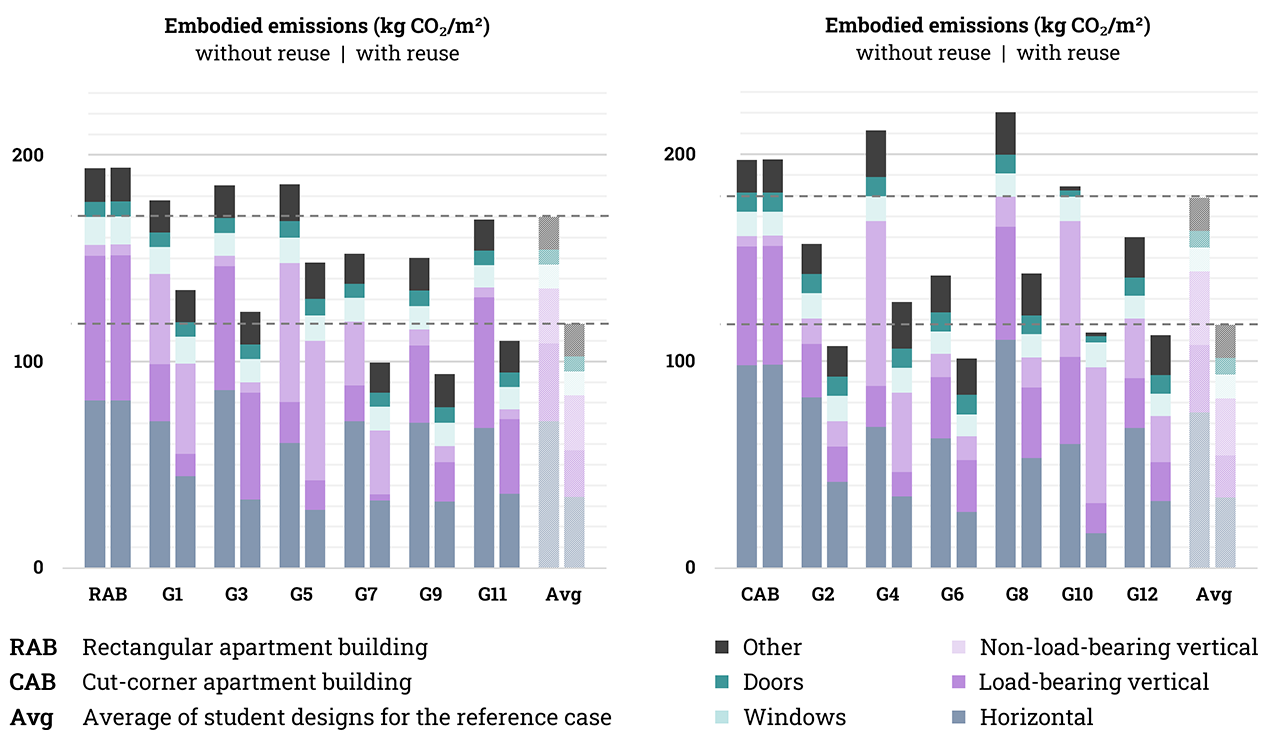
Figure 4. Embodied emissions in the reference cases and corresponding student designs. Each design comprises a single storey of a single stairwell unit in the middle of a building. Thus there is no roof or foundations included, and floor slabs are only counted once. Each pair of columns corresponds to a single design, with the ‘without reuse’ scenario (all virgin materials) on the left and ‘with reuse’ on the right.
Based on feedback, the students found the course interesting and considered the skills acquired relevant for their future work as architects. Many specifically pointed out the technical design aspects and emission calculations as being important and at the same time something they had not learned to the same extent in other parts of the degree.
The course was organised in collaboration with ReCreate and supervised by Prof. Satu Huuhka, Dr. Tapio Kaasalainen, and Dr. Jyrki Tarpio.