

Connector scale - Recreate

April 14, 2026
Matias-Pajarre-TAU-3.jpg

Introduction to the report: Building, component, and connector typologies of precast concrete building systems of the ReCreate project. The full report is available here.

Erik Stenberg, KTH

What kinds of different precast concrete elements (PCE) are there out there and what do we call them?  

The Recreate report D1.2 Building, component, and connector typologies of precast concrete building systems explores how precast concrete elements (PCEs) can be organized and named more effectively. To support reuse, it proposes a simple way of organizing knowledge about these elements at three different scales: 1. the building scale, 2. the component scale, and 3. the connector scale. Looking at PCEs across these scales helps describe how they relate to one another and how their physical characteristics influence reuse. 
The report introduces an ordering system and naming convention for PCEs. Diagrams and short explanations show how elements behave and interact at each scale. Key diagrams summarize the main findings at three scales separately and then combined into one shared system for naming and understanding reused precast elements. 

A key step in enabling reuse is understanding the material and functional characteristics of PCEs. This step is often overlooked. In this report, both quantitative data (such as dimensions and structural capacity) and qualitative aspects (such as typology or function) are analyzed at the three scales to show how they influence reuse. 

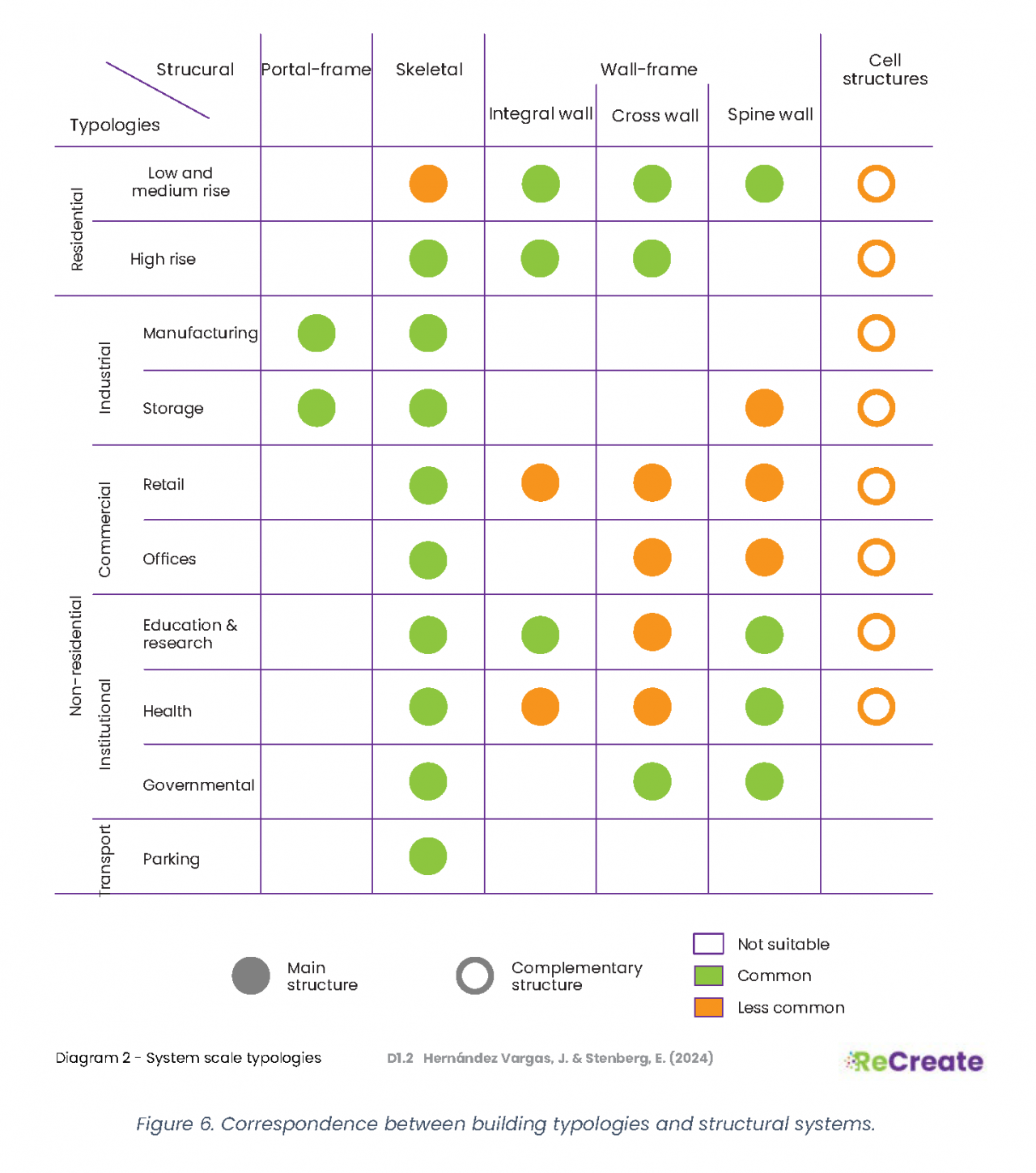
At 1. The building scale, precast elements are part of a larger structural and functional system. The way elements are combined affects what kinds of buildings they can form. In turn, building types also influence which element types are suitable. For example, certain structural systems or building layouts work better with specific precast elements. 

At 2. The component scale, the report examines the properties of individual precast elements. These include their form, dimensions, and historical use. Information from past building practices and Building Information Modeling (BIM) is compared to better understand typical element types and how they might be reused. 

At 3. The connector scale, the focus is on how elements are joined together. The type of connection affects how easily elements can be assembled, disassembled, and reused. Some elements are more compatible with certain connectors than others.  

Together, these three scales show how elements, connections, and building systems are closely linked. 
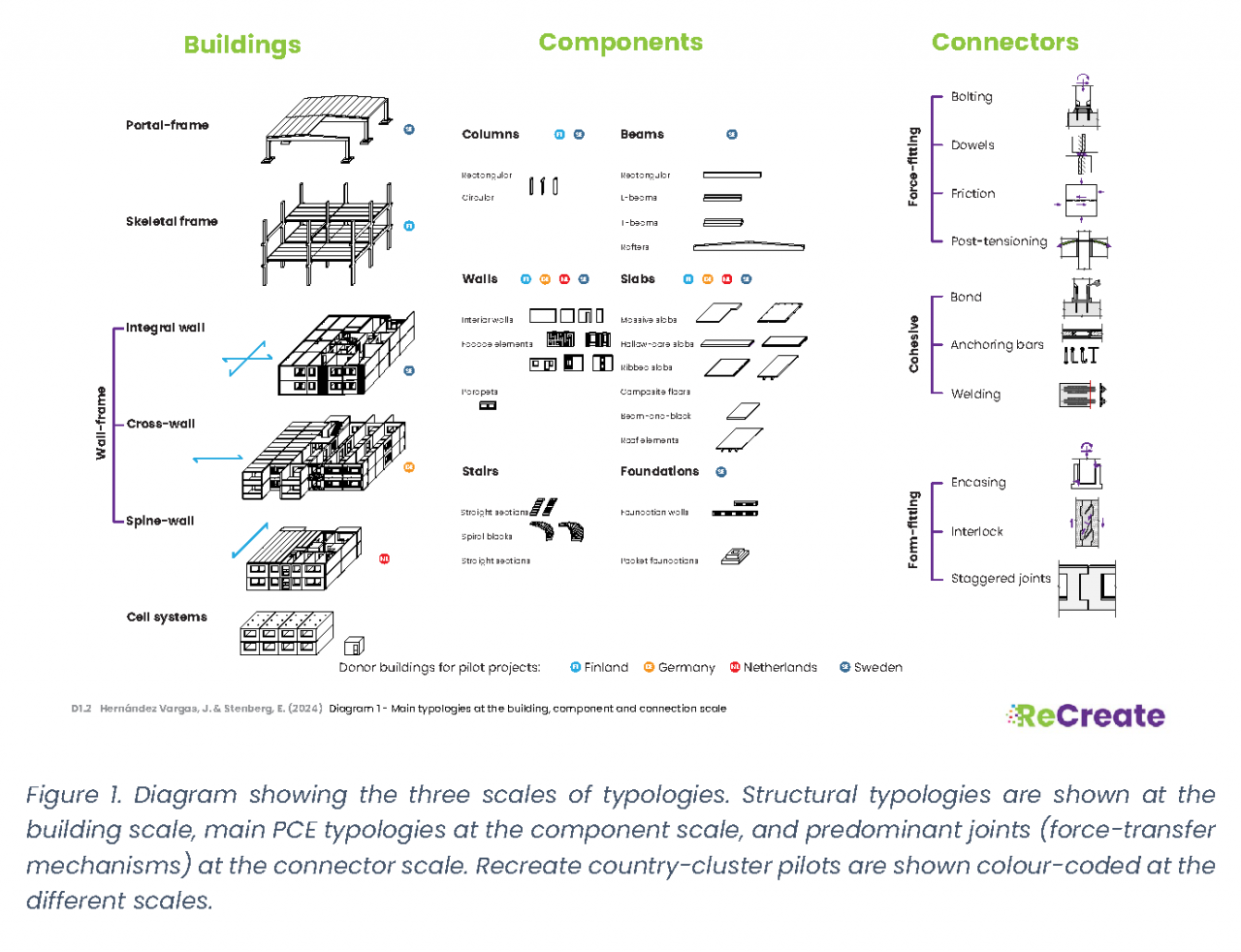
The report also proposes a common nomenclature for describing PCEs across the three scales. This naming system provides basic categories for identifying and classifying elements. The typological names used in the diagrams and charts act as references that help interpret and categorize elements.

Overall, this work is an early step toward creating a taxonomy of precast building systems. This taxonomy provides a framework for classifying precast systems, elements, and structural details. In the future, it will serve as a shared knowledge base that supports the reuse of precast concrete elements and the development of digital databases of reusable building components.



February 28, 2024
Jose-Hernandez-Vargas_ReCreate-blogpost.png

José Hernández Vargas

Architect and PhD student at KTH Royal Institute of Technology

A precondition for reusing precast elements is a correct understanding of the underlying logic of different building systems and the structural interactions between concrete elements. The analysis of existing precast systems starts with a thorough examination across multiple scales, as building layouts, individual elements and their connections are interdependent.

During ReCreate, several precast concrete systems have been identified and studied. While specific pre-demolition auditing and quality control are critical steps towards reusing concrete elements, this ordering of precast elements operates at an earlier and more abstract level, providing a knowledge base for known precast systems that may apply to multiple instances. This task attempts to provide an overview and develop guidelines for the further classification and digitalisation of precast elements as potential material for reuse. Moreover, the information gathered can serve as methodological guidelines for other systems that may differ from the studied cases but follow the same core principles.

When examining technical drawings from historical precast systems it is important to identify patterns that reveal the systematic ordering of the elements. This initial step involves identifying the underlying measurement system from the axes of the building, from which standard layouts can be inferred in discrete modules. Strict repetition patterns can often be found, especially in residential buildings, where building blocks are constituted by the repetition of a building module defined by a staircase. Similarly, this building module can be divided into residential units corresponding to the individual flats on each floor. Each unit defines in turn a defined arrangement of precast elements that can be precisely estimated for each building.

Thus, architectural and structural knowledge of precast buildings is essential for accurately estimating the building stock and potential for reuse of precast buildings. Given the economies of scale involved in this kind of building, the goal of this step is to build a knowledge base to establish workflows for the ordering and analysis of potential donor buildings for reuse.

Building scale

At the building scale, the analysis centres on the identification and classification of precast structures by structural principles and different building types. Precast buildings can be found in all sorts of applications. Yet, despite the wide range of structural solutions they predominantly follow a limited set of basic structural systems. The most prevalent structural frameworks for precast concrete include the portal-frame, skeletal structures, and wall-frame structures. Structural systems for arranging precast structural systems are closely linked to the building types they serve, responding to the intended program’s requirements. For example, portal-frame structures are most suitable for industrial buildings that require large open spaces. Conversely, for residential buildings wall-frame structures are more often the most cost-effective solution as load-bearing walls also separate living spaces. Beyond buildings completely built out of precast components, specialised subsystems can be found for facades, floors and roofs in combination with other structural systems.

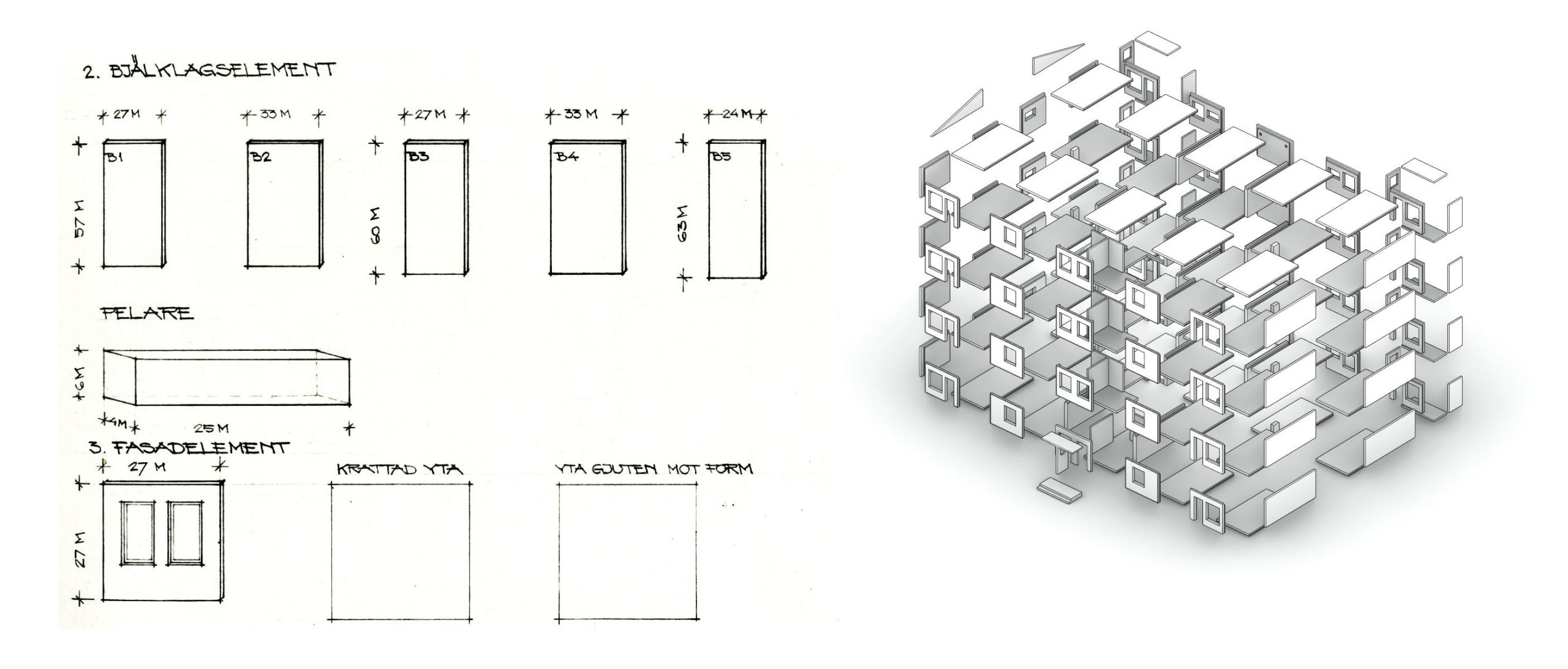
System Skarne 66 (Sweden) and their main structural components form the original technical drawings (left) and as a digital 3D model (right)

Component scale

At the scale of individual precast elements, the foremost classification derives from grouping them by their structural role in the structure, i.e., as walls, columns, slabs, roofs, beams, foundations, and stairs that constitute the structure of the building. These categories are based on the Industry Foundation Classes (IFC) Standard (ISO16739-1), which provides a consistent framework for describing elements within the construction industry. These groups can be understood and modelled as variations of the same parametric object, akin to a family of building components. This process is key for building a comprehensive database of precast elements contained in each building.

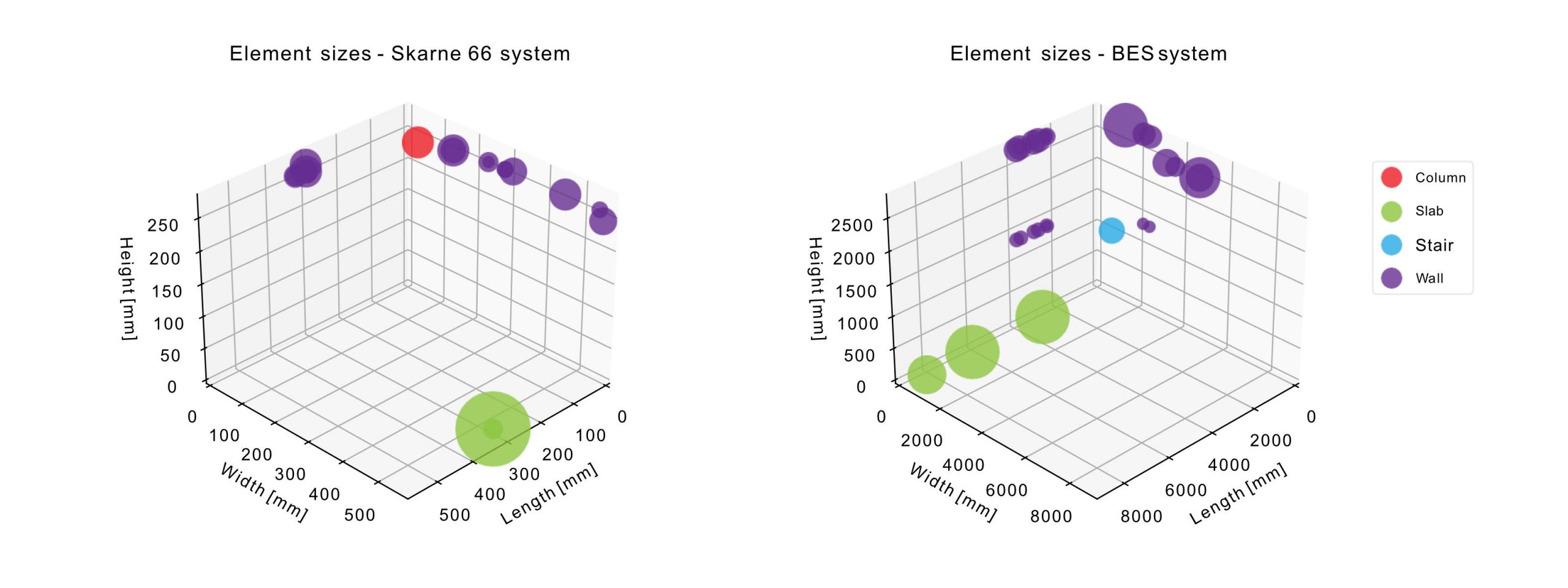
To further understand the arrangement of elements that constitute a system, the overall dimensions of each element can be plotted to reveal the dispersion of distinct types within the system. In this example, all the elements are aligned in Cartesian space to define the largest dimension on each axis. This method allows the creation of a ‘fingerprint’ of each building, that shows a concise overview of the dispersion of element types and the individual quantities involved. Alignments resulting from common features such as floor heights and standard modules, can also be observed.

Comparison of the ‘fingerprint’ tool showing the types of elements used in System Skarne 66 (Sweden) and BES (Finland). Dot size indicates the number of elements of each type whereas colour corresponds to the main component categories.

Connector scale

At the connector scale, the different relationships between concrete elements can be related to force transfers and security features to ensure the correct and reliable transmission of forces. Connectors are key to ensuring structural integrity by managing structural loads while accommodating additional stresses and strains that arise from thermal movements, residual loads, seismic loads, and fire exposure, among others. A key aspect for evaluating the connectors is the assessment of the alternatives for disassembly and possibly reusing the connector. Analysing precast buildings at the connector scale allows the identification of the compatibility of precast elements across multiple systems from the analysis and comparison of structural details.

Ordering precast systems across these three scales provides a comprehensive picture of how precast systems are conceived, manufactured, and assembled. This knowledge is instrumental for understanding the possibilities that these elements offer for the next building lifecycle. This ordering will serve as the basis for classifying different precast systems into taxonomies and for the digitalisation of existing precast stocks as material for reuse in future projects.


EU FUNDING

“This project has received funding from the European Union’s Horizon 2020 research and innovation programme under grant agreement No 958200”.

Follow us: